
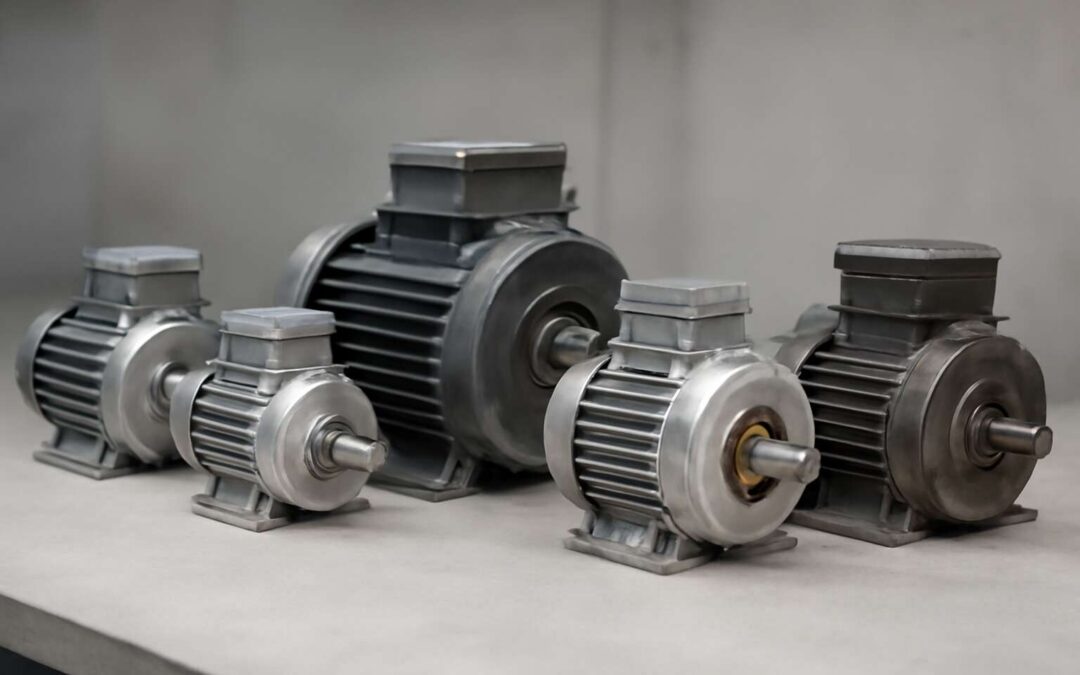
Five Key Electric Motor Types
Induction Motors: Principles and Variants – Overview of squirrel cage and wound rotor designs, typical industrial applications and efficiency profiles.
On South Africa’s factory floors, the hum of motors shapes production—and energy use; induction motors can account for a sizable share of plant electricity, often nearing 40% in heavy industries. In the spectrum of 5 electric motors, induction machines stand tall for reliability and energy profile. These devices hinge on a simple truth: rotor currents are induced by a magnetic field, so speed stays aligned with the supply. Two enduring designs define the category: the rugged squirrel cage and the flexible wound rotor.
The squirrel cage rotor relies on copper or aluminum bars within a laminated core, delivering rugged reliability with minimal maintenance. It shines in continuous-duty roles like pumps and conveyors. The wound rotor adds slip rings and external resistors, enabling smoother starting and torque management. Efficiency scales with load and frame size, pushing some designs toward higher IE ratings.
DC Motors: Brushed and Brushless Options – When to select DC motors, speed control methods, maintenance considerations.
DC motors deliver instant torque on demand, a feature South Africa’s factory floors lean on for reliable line starts. In the spectrum of 5 electric motors, DC machines carve out a practical niche: affordable, dependable, and easy to source locally. Brushed and brushless designs sit at opposite ends of the reliability and maintenance spectrum, offering distinct trade-offs.
Brushed DC motors are rugged, cheap, and forgiving—perfect for conveyors and pick-and-place tasks that tolerate a bit of wear. Brushless DC motors run cooler, deliver higher efficiency, and longer life, but demand a drive for commutation. When to select each? Consider starting torque versus long-term maintenance.
- Speed control methods: PWM, voltage control, current regulation
- Maintenance considerations: brushes wear in brushed motors; electronic drives extend life in brushless
- Environmental factors: dust, moisture, and duty cycle influence performance
Choosing between these DC options in your portfolio of 5 electric motors comes down to total cost of ownership and operational smoothness; the right pick keeps lines humming and maintenance crews happy.
Synchronous and Permanent Magnet Motors – Differences from induction motors, torque characteristics, and efficiency benefits.
Factories in South Africa chase efficiency with laser focus. Synchronous and permanent-magnet motors stand out from induction designs for precision and efficiency. They maintain speed under load and deliver torque characteristics that keep automated lines steady, even when the floor heat climbs.
- Rotor type: a permanent magnet or reluctance rotor locks rotor speed to the magnetic field, unlike induction’s slip-prone rotor.
- Torque characteristics: high starting torque and near-constant speed under varying loads, ideal for servo-like tasks.
- Efficiency benefits: lower copper losses and higher power density, translating into cooler operation and smaller gearboxes.
These machines slot neatly into the 5 electric motors lineup, delivering reliability and cooler operation in SA’s dusty, humid factory environments.
Precision and Special Purpose Motors – Stepper and servo motors for robotics, CNC, and high-positioning accuracy.
In SA’s precision-driven factories, the 5 electric motors lineup proves that small motions wield outsized influence. Stepper and servo motors shine in robotics, CNC, and high-positioning accuracy—quiet dynamos that deliver repeatable steps or real-time torque with calm certainty. As one engineer says, “Precision is a conversation between motor and controller.”
Stepper motors offer extraordinary incremental control through microstepping and simple drive electronics, ideal for steady, low-speed positioning. Servo motors bring closed-loop feedback, encoder data, and high dynamic torque that preserves accuracy at speed, even under shifting loads. The 5 electric motors family pairs these traits with rugged construction for SA environments.
- Stepper motors: open-loop positioning with microstepping, simple drives, and repeatable motion.
- Servo motors: closed-loop control, encoder feedback, and torque-rich performance at speed.
- Best fit: robotics, CNC, and high-positioning accuracy tasks that demand reliability.
Choosing the Right Motor for Your Application
Evaluate Load, Speed, and Torque Requirements – How to match motor type and sizing to performance needs and duty cycle.
Across SA workshops, a mis-sized drive can drain performance and energy—some studies report up to 20% wasted power when loads aren’t matched to duty. This first contact with a motor choice should feel deliberate, not accidental.
To pick the right motor for your application, evaluate load, speed, and torque requirements. Consider peak torque at start-up, continuous torque during run, and how often the load changes. Duty cycle matters: a motor sized for brief bursts must not live at full bore; pick an option that tolerates the rhythm of your process.
- Load profile and acceleration demands
- Torque requirements at operating speed and during start-up
- Duty cycle and cooling capacity to sustain performance
With these checks, you’ll see how the 5 electric motors in our catalog align with your performance targets, ensuring efficiency, longevity, and dependable operation on South African floors.
Assess Efficiency, Operating Costs, and Temperature – Energy usage, cooling needs, and long-term cost implications.
Across SA workshops, studies peg wasted power from poorly matched duty at up to 20%, turning energy savings into a political and economic issue as much as a technical one. Choosing the right motor for your application is where practical performance begins. Efficiency, operating costs, and temperature are intertwined: a motor that runs cooler, with lower losses, reduces both energy bills and cooling demand in the plant.
Key factors to weigh:
- Energy usage: efficiency class, losses, and long-term electricity costs
- Cooling needs: ambient temperature, ventilation, and heat rejection
- Lifetime costs: maintenance, replacements, and downtime implications
The 5 electric motors in our catalog offer a mix of efficiency classes and cooling options to match South African floor realities, ensuring long-term cost symmetry and dependable operation.
Consider Size, Weight, Mounting, and Enclosure – Mechanical fit and environmental protection considerations.
Up to 20% of motor energy is wasted in SA workshops when the duty is poorly matched. The right choice for the 5 electric motors in our catalog hinges on mechanical fit and enclosure as much as on ratings. Size and weight determine how it mounts to existing frames, while the enclosure protects against the plant environment and maintenance access.
Match the motor’s footprint to your frame, confirm shaft alignment, and choose an enclosure that resists dust and moisture. Consider these factors:
- Size and weight for mounting and handling
- Mounting style (foot, flange, or face) for alignment
- Enclosure rating (IP) and heat rejection access
- Environmental exposure and maintenance access in SA workshops
Drive and Control Compatibility – Interfaces, controllers, and closed-loop vs open-loop options.
Power flows smoothly when the motor and drive speak the same language. In SA factories, tiny interface mismatches can erode performance and raise maintenance costs. The right fit for the 5 electric motors in our catalog harmonizes control, feedback, and the plant’s rhythm.
Drive and control compatibility threads through interfaces, controllers, and the choice between closed-loop and open-loop systems. Pair a motor with a drive that shares signals, feedback, and a compatible protocol, and you gain smooth acceleration and reliable torque.
- Interfaces: fieldbus, analog/digital I/O, CAN, EtherCAT
- Controllers: VFDs, servo drives, PLC-based motion controllers
- Feedback: encoders, resolvers, or sensorless options
These choices shape every project, especially where service access matters in SA. Aligning interfaces, control mode, and drive creates predictable, steady motion across your lines.
Reliability, Maintenance Needs, and Lifecycle – Maintenance schedules, mean time between failures, and lifecycle costs.
In SA factories, downtime costs real money—one hour can erase a shift’s output. When evaluating 5 electric motors, reliability, maintenance needs, and lifecycle costs become the hidden levers of value. A motor aligned with the plant’s duty cycle keeps MTBF steady and maintenance calls to a minimum.
Maintenance schedules must balance reliability with South Africa’s operating conditions and spare parts access. Consider the total lifecycle cost—bearings, windings, insulation health—not just the upfront price. Service-friendly design and robust cooling curb outages and keep performance steady.
- Lubrication and bearing wear
- Insulation health and thermal monitoring
Choosing the right motor for long-term reliability and maintenance pays dividends when plant lines run through the night.
Motor Technology Deep Dive
Induction vs Brushless DC Motors: Core Trade-offs – Performance, efficiency, and cost considerations.
In South Africa, drive systems can account for a sizable share of energy costs, so choosing the right motor matters—and the subtle trade-offs can unlock surprising gains.
This deep dive into induction versus brushless DC motors guides that choice for the 5 electric motors in your line.
Consider these core trade-offs.
- Performance fit: BLDCs excel at precise control and rapid torque; induction provides reliable, straightforward torque across wide ranges.
- Efficiency and heat: BLDCs typically offer higher efficiency over duty cycles; induction is robust, but can heat more under light loads.
- Cost profile: BLDCs need controllers and sensors, raising upfront costs; induction motors are often cheaper to buy and replace.
For the line in a South African plant, weighing duty cycles, maintenance, and lifecycle costs reveals the best match.
Permanent Magnet vs Synchronous Motors – Magnet materials, torque characteristics, and control strategies.
In the shadowed heart of drive lines, Permanent Magnet and Synchronous motors bend power to purpose. Magnet materials shape their voice: NdFeB magnets unleash high torque density, while SmCo handles heat and demagnetization with a cooler, steadier breath. Synchronous designs—whether magnet-equipped or reluctance-based—offer steady torque and crisp speed control across wide ranges. In the 5 electric motors lineup, this family stands out for precision, resilience, and a whisper-quiet efficiency!
Key differentiators include:
- Magnet materials: NdFeB for high torque density; SmCo for temperature stability and demagnetization resistance.
- Torque characteristics: PM motors deliver high torque density and rapid response; synchronous designs emphasize smooth torque with low ripple across speed.
- Control strategies: Field-oriented control (FOC) and direct torque control (DTC), with sensorless rotor position estimation for robust operation.
These traits shape efficiency and reliability under South African duty cycles, where uptime and maintenance windows often tilt the decision.
Stepper vs Servo for Precision Control – Positioning accuracy, speed, and feedback requirements.
Stepper motors and servo motors each claim precision, but their roadmaps diverge quickly. Positioning accuracy, speed, and feedback requirements are the trio that decide fit for purpose in the 5 electric motors lineup. Steppers excel in cost‑effective positioning with high repeatability at modest speeds, while servos deliver robust closed‑loop accuracy under rapid accelerations and heavy loads. For many South African manufacturing cells, the choice hinges on how tight the feedback loop needs to be and what uptime demands truly look like.
Key contrasts to weigh:
- Positioning accuracy and repeatability: Stepper microstepping offers predictable moves but may drift under load; servo encoders maintain exact position through the move.
- Speed and dynamic response: Servo systems hold torque to high speeds; stepper performance drops as acceleration climbs.
- Feedback and control complexity: Open‑loop stepper control is simpler and cheaper; servo systems rely on closed‑loop feedback for reliability.
Thermal Management, Noise, and Vibration – Cooling methods, acoustic profiles, and mechanical design impacts.
Heat is the silent antagonist that shortens motor life and wrecks uptime in demanding environments. In the real world, heat-induced stress takes a toll, especially in hot South African plants where ambient temperatures climb. For the 5 electric motors lineup, thermal management isn’t an afterthought—it shapes duty cycle, reliability, and total cost of ownership.
Cooling methods vary from brisk air cooling with refined fin geometry to sophisticated liquid loops that carry heat to a compact exchanger. Consider the options:
- Convectional air cooling with optimized fins
- Liquid cooling loops and heat exchangers
- Immersion or spray cooling for extreme duty
Noise and vibration follow mechanical choices; fan blade acoustics, bearing design, and enclosure stiffness determine the acoustic profile. Proper mounting and isolation dampen vibrations that can accelerate wear, while a thoughtful enclosure reduces radiated noise, preserving throughput in sensitive spaces.
Applications Across Industries
Industrial Automation and Robotics – Applications in manufacturing lines, pick-and-place, and CNC machines.
Factories across South Africa chase uptime with the swagger of a springbok on a sprint. Applications across industries hinge on robust, finely tuned motion—from conveyors and pick-and-place cells to the precise choreography inside CNC machines. The right 5 electric motors keep lines moving with rhythm, repeatability, and a touch of personality that makes automation feel approachable—without sacrificing performance.
- Conveyor systems powering high-throughput packaging lines
- Robotic pick-and-place cells in assembly and sorting
- CNC spindles and tool changers delivering precise finishes
Beyond speed, these motors shape control interfaces, maintenance windows, and energy footprints that keep operating costs honest.
HVAC, Appliances, and Commercial Equipment – Motors in fans, compressors, and household devices.
Across South Africa, the pace of modern life relies on the quiet discipline of dependable motors in HVAC, appliances, and commercial gear. The 5 electric motors that power fans, compressors, and household devices exert a quiet gravity on comfort and efficiency. The hum of a well-tuned motor is the heartbeat of a bustling space—graceful, precise, and a little electric poetry!
Beyond mere speed, they govern maintenance windows, noise profiles, and energy footprints that matter to facilities managers.
- Fans in HVAC systems for steady, quiet cooling
- Compressors in refrigeration and air-conditioning for dependable climate control
- Pumps and drives in commercial equipment that move liquids and materials
Here in SA, durability, enclosure protection, and local service shape every choice, turning a practical engine into a steadfast partner. The right motor makes facilities feel effortless, almost lyrical, as we witness comfort, cleanliness, and efficiency cohere in daily life.
Automotive and Electric Vehicles – Drivetrain motors, actuators, and propulsion support.
Power is quiet, precise, and relentless—the propulsion heartbeat behind modern cities. In automotive and electric-vehicle applications, 5 electric motors power drivetrain efficiency, actuators, and propulsion support with refined torque choreography and responsive control.
These motors blend compact packaging with robust control strategies, enabling smooth acceleration, regenerative braking, and adaptive motion across terrains. They are sized to match load profiles, with enclosure protection suited to tough SA conditions and service networks that keep fleets moving.
- Drivetrain motors
- Actuators and propulsion drives
- Thermal management and reliability considerations
Aerospace, Medical, and Renewable Energy – Specialized motors for precision, reliability, and efficiency.
Across South Africa’s aerospace, medical, and renewable energy sectors, precision is not a luxury—it’s a mandate. The 5 electric motors at the heart of these systems deliver dependable torque, exact positioning, and enduring efficiency, turning bold design into reliable performance.
In aerospace, these compact drivers fuel flight-control actuators, landing gear, and gyroscopic stabilizers, where every microstep matters.
- Lightweight actuation for reduced fuel burn
- High-precision positioning under rapid thermal swings
- Rugged performance in vibration-rich cabins and airframes
In medical tech, tiny, cleanable, and reliable motors power surgical robots, imaging devices, and wearables, delivering smooth motion and unwavering repeatability.
In wind and solar, sturdy motors track sun, regulate valves, and drive gearboxes, marrying efficiency with resilience in remote, harsh environments.
Maintenance, Safety, and Best Practices
Preventive Diagnostics and Common Failure Modes – Tips for predictive maintenance and fault detection.
Maintenance for 5 electric motors is a quiet, strategic vigil—one that keeps downtime at bay and performance sharp. Regular inspections, lubrication, fastener checks, and enclosure status feed a healthy lifecycle. Subtle cues—a shifting hum or a creeping rattle—can foreshadow a fault and save thousands.
Safety remains non-negotiable in busy South African workshops. De-energize before work, apply proper lockout-tagout, secure guards, and keep walkways clear. Modern drives help, but human vigilance, PPE, and clear signage are the first line of defense against shock, arc flash, and accidental startup.
- Vibration analysis to detect bearing wear and unbalance
- Thermal imaging to spot overheating windings or bearings
- Insulation and winding resistance tests to catch insulation degradation
Best practices for predictive diagnostics and recognizing common failure modes rely on trend data, non-destructive testing, and disciplined maintenance intervals. The result is reliability across 5 electric motors and peace of mind for operators.
Lubrication, Bearings, and Seal Handling – Maintenance routines to extend bearing life and performance.
From the dawn light over South Africa’s workshops, 5 electric motors hum with stubborn reliability. Maintenance is a quiet vigil—one that keeps downtime at bay and performance sharp. Regular inspections, clean enclosures, and mindful lubrication cues sketch the lifecycle on the shop floor.
Safety remains non-negotiable in busy South African workshops; a culture of proper energy control, secure guards, and uncluttered work areas forms the first line of defense against shock, arc flash, and accidental startup.
Best practices for predictive diagnostics hinge on trend data and non-destructive testing, yet longevity rests in how we manage lubrication, bearing surfaces, and seal interfaces. Subtle shifts in heat, noise, or vibration tell a wear story, guiding maintenance rhythms without shouting for attention.
Cooling Solutions and Thermal Monitoring – Strategies to manage heat during operation.
Heat is the quiet antagonist in South Africa’s bustling workshops, where shadows linger around 5 electric motors. Maintenance becomes a ritual that preserves calm operation: clean enclosures, unobstructed airflow, and watchful eyes on temperature readouts guiding performance. When cooling paths sing and vents breathe freely, uptime stays loyal and efficiency holds steady.
Safety remains non-negotiable—secure guards, clean energy controls, and uncluttered floors. For cooling and thermal monitoring, non-contact thermography and trend checks illuminate hotspots before trouble blooms. Subtle temperature shifts, captured in a thermal image, tell the wear story without shouting.
For the electric motors powering South Africa’s lines, thermal management is the backbone of reliability and lifecycle value.
Safety Standards, Installation, and Compliance – Standards to follow for safe installation and operation.
South Africa’s busy workshops talk softly, but heat is the real antagonist. For the 5 electric motors that keep lines moving, maintenance becomes a ritual: clean enclosures, clear airflow, and temperature logs that whisper trouble before it blinks. When cooling paths sing, uptime stays loyal and efficiency holds steady.
Safety is non-negotiable—guards in place, clean energy controls, and tidy floors. A quick non-contact thermography scan spots shy hotspots before they bloom; a steady trend check turns potential drama into predictable performance.
Standards and installation are the quiet backbone of reliability. Follow local codes and international best practices to protect lives and assets; secure mounting, proper enclosures, and traceable approvals prevent surprises. For the motors in your facility, here are touchstones:
- SANS 10142-1 (Electrical installations)
- IEC 60034-1 (Rotating electrical machines)
- ISO 13849-1 (Safety of machinery)