
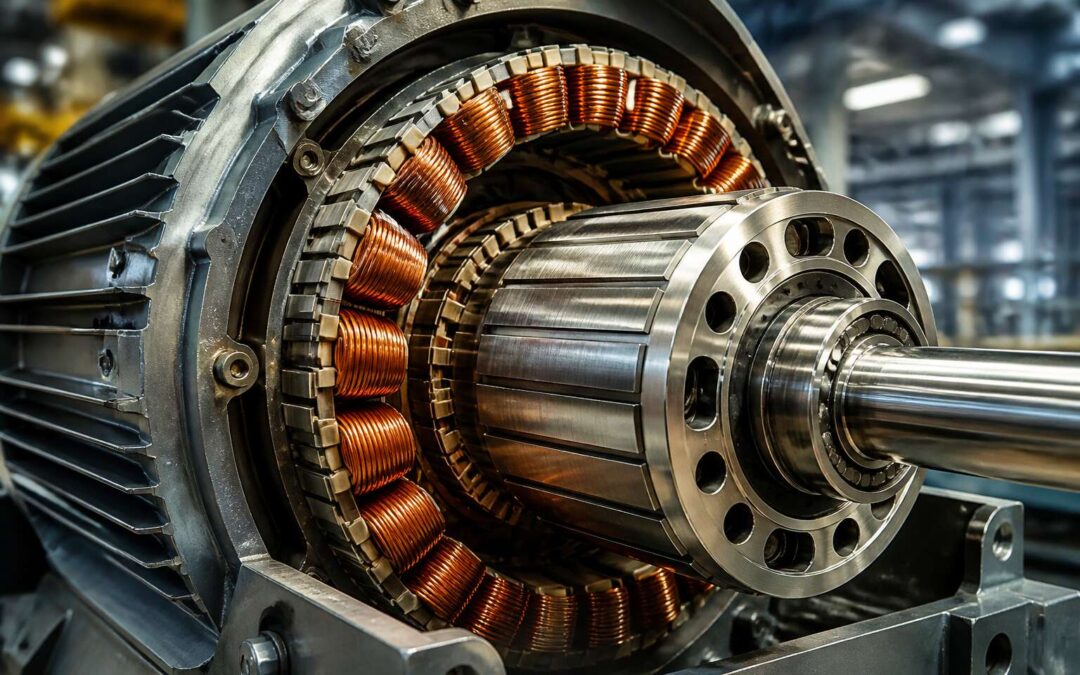
Understanding Motor and Generator Fundamentals
Basic Principles of Electromagnetic Induction
In 1831, Michael Faraday observed that a moving magnetic field creates an electrical flow in a nearby conductor. That discovery underlies every electric motor and generator you will ever touch. For engineers across South Africa, this principle is not theoretical. It is why our machinery turns and our power stations deliver.
Electric motors generators share a fundamental symmetry. In a motor, electrical energy produces torque. In a generator, mechanical rotation produces electrical output. Both depend on electromagnetic induction. A conductor moving through a magnetic field, or a field moving past a conductor, causes electrons to shift.
- Induced voltage depends on magnetic field strength.
- Induced voltage depends on the speed of relative motion.
These two variables govern everything from small portable units to large turbine halls.
Key Differences Between Motors and Generators
In South Africa, electric motors generators share a fundamental structure but serve opposite functions. A motor converts electrical current into mechanical rotation. A generator converts mechanical rotation into electrical current. That reversal shapes design choices across every industrial application.
The core differences are straightforward:
- Motors draw current to produce torque.
- Generators draw torque to produce current.
- Motors follow grid frequency, generators set it.
Each machine prioritises a distinct outcome. Motors focus on torque and speed control. Generators focus on voltage stability and synchronisation.
How Energy Conversion Works
Most equipment failures trace back to a misunderstanding of energy conversion. Every machine in your plant performs a single act of electromechanical transduction. The stator produces a rotating magnetic field from three-phase current. That field drags the rotor along, transforming electrical energy into kinetic energy. Reverse the input, and the same machine behaves differently. Apply torque to the shaft, and the rotor spins inside that magnetic field, producing voltage. Electric motors generators in South African industry follow this exact reciprocity.
The practical implications for local operations deserve attention:
- Motor efficiency depends on slip and load factor.
- Generator output relies on excitation and speed regulation.
- Both face thermal stress, harmonic distortion, and bearing wear.
We’ve all seen engineers treat motors and generators as separate disciplines. They miss the connection. Understand that electric motors generators are two expressions of one electromagnetic principle. That mindset changes how you approach maintenance and lifecycle planning!
The Role of Magnetic Fields in Operation
Some engineers still believe that magnetic fields behave differently inside a motor versus a generator. That assumption costs time and money in maintenance planning. In reality, the rotor and stator interactions remain identical, only the direction of energy flow changes. Internal magnetic flux creates torque in one case and voltage in the other.
Consider what happens inside a squirrel cage rotor. The rotating field sweeps across the rotor bars, inducing current. That current produces its own magnetic field, and the two fields lock together. This principle holds whether the machine draws current from the grid or supplies current to it. On a South African mine site, a single failed bearing can blur the line between generation and motoring, because the same physical stresses apply to both modes.
Understanding this reciprocity helps teams inspect for common failure points.
- Air gap uniformity determines how effectively magnetic flux transfers between stator and rotor.
- Rotor bar integrity affects both starting torque and voltage stability.
- Excitation system health directly influences reactive power output.
Each of these checks applies to equipment running in either direction. Local conditions, including heat, dust, and voltage dips, act on the magnetic circuit first. When the field weakens, the machine draws more current to maintain output. That imbalance accelerates insulation aging and shortens service life. Teams that recognise electric motors generators as shared magnetic systems gain better diagnostic insight.
Exploring Commutation and Brush Systems
On the South African highveld, where dust and altitude punish rotating machinery, the brush gear is the most exposed component in any wound-field machine. Carbon brushes carry current across the mechanical boundary between stator and rotor. Their wear patterns reveal more about machine health than most vibration charts.
Commutation is the art of switching current at the precise moment the coil passes the magnetic neutral axis. Get it right, and the machine hums. Get it wrong, and the commutator surface develops bright spots and pitting within weeks.
Crews watch for:
- Brush seating and bed-in cycle
- Spring pressure and arcing
- Protective oxide film on the commutator
These checks apply equally to electric motors generators on underground conveyors and surface winders. Physical laws do not shift when the machine changes role. Understanding commutation extends service intervals for electric motors generators.
Exploring Different Types of Electric Motors
DC Motors vs. AC Motors
Nearly 45% of global electricity flows through industrial motors, yet the DC versus AC debate persists. In South Africa, where load shedding tests every operation, selecting the right electric motors generators system can determine uptime. DC motors offer surgical speed control, a boon for winches and mixers. AC motors, by contrast, deliver rugged reliability for pumps and compressors.
Consider these distinctions:
- DC: high starting torque, easy to regulate speed.
- AC: constant speed, lower maintenance overhead.
I’ve seen plants waste fortunes on mismatched electric motors generators. A crane requires DC’s precision, while a ventilation fan thrives on AC’s simplicity. The answer lies in your load profile, not in fashion. Choose accordingly.
Brushed vs. Brushless Motor Designs
Brushed motors have carried industry for a century, their carbon brushes wearing down steadily. Brushless designs replace that friction with electronic commutation. In South African plants where load shedding throttles production, this difference dictates uptime. Brushed units demand constant inspection, while brushless systems run sealed and cool. For any electric motors generators setup, the motor choice outweighs the generator itself.
Here’s what I check on site:
- Brushed: check brush wear, spring tension, commutator glazing.
- Brushless: verify hall sensors and controller firmware.
The latter saves hours of maintenance every quarter. I’ve watched entire shifts lose production to a stuck brush. A brushless motor never costs you that hour! That’s the honest arithmetic for a country fighting for every watt.
Induction Motors and Their Applications
For every electric motors generators installation that survives a South African shift, the induction motor proves its worth. Unlike brushed designs, these machines draw no current through sliding contacts. They rely on rotating magnetic fields and induced rotor currents instead. That simplicity explains why you find them driving crushers, conveyors, and pumps across the Highveld.
Three phase squirrel cage motors dominate industrial floors, while wound rotor variants handle high starting torque. Single phase induction motors power smaller loads like fans and compressors.
- Steel mills use slip ring motors for heavy starts
- Mines prefer squirrel cage units for conveyor drives
- Water utilities choose capacitor start motors for borehole pumps
Each choice shapes your overall motor strategy. Understand the load profile, protect against phase loss, and the induction motor will outlast every other component.
Synchronous Motors for Precision Tasks
We admire precision in everything from a well struck golf ball to a perfectly timed traffic light sequence. Inside the industrial world, the synchronous motor is that paragon of accuracy. This machine operates at a fixed speed, locked to the frequency of the supply. It does not slip, hesitate, or wander. This constant rotation makes it the definitive choice for tasks where exact timing is non-negotiable.
You might not think about the phasor alignment of the rotor and stator, but you see the result every day in South African manufacturing. These units run conveyor systems that demand exact batch counting, and they drive machinery in paper mills and steel plants.
– Robotics and automation lines
– Compressor and blower drives
– Precise extrusion processes
However, you cannot simply wire one to the grid and hope for the best. They require a Variable Frequency Drive (VFD) for proper starting. Skip the VFD, and you might experience a dramatic electrical event, which is a polite way of saying a very expensive bang.
For engineers chasing tight tolerances, the synchronous motor offers a clear advantage. These units operate with a leading power factor. This quality assists in correcting the lag created by other equipment on your site. When you evaluate electric motors generators, they often serve as power factor correction tools, not just mechanical movers. The efficiency is remarkable, but the necessity for precise control is your main consideration. If your process needs exact speed control without mechanical gearboxes, this motor design diverts from the common induction reality and heads straight for the finish line with unhurried certainty.
Specialized Motor Topologies for Unique Needs
Some applications refuse to fit a standard motor frame. That is where specialist designs earn their place. A switched reluctance motor runs without magnets or rotor windings, a robust choice for dusty mining environments around Johannesburg. These machines tolerate high temperatures and deliver strong torque.
The axial flux motor uses a flat disc arrangement to produce high power density in a slim package, valuable where floor space is tight. Linear motors skip rotary conversion entirely, providing direct motion for sorting systems and precision cutters.
When you evaluate electric motors generators for unusual duties, look past catalogue standards.
- Switched reluctance for harsh, high speed work
- Axial flux for compact, high torque installations
- Linear motors for direct linear travel
Matching the topology to the task prevents breakdowns and wasted energy.
Generators and Their Applications
Portable Generators for Emergency Power
In South Africa, load shedding is a recurring test of patience. A portable generator is a reliable source of emergency power, turning a stalled household back into a functioning one. I have watched families gather around a single extension cord, prioritising the fridge.
These machines combine a combustion engine with an alternator, converting mechanical energy into electrical output. The cycle mirrors the internal workings of electric motors generators, but the stakes are personal. When the grid fails, the generator restores order.
- Keeping medical devices running during outages
- Maintaining security systems and alarms
- Preventing food spoilage for refrigerators and freezers
Selecting the right unit requires an honest assessment of your electrical load. Overloading a generator damages the alternator and creates fire hazards. Without municipal power, this machine carries real responsibility. The quiet hum of a generator, like electric motors generators in industrial settings, signals continuity, and I feel that relief every time!
Standby Generators for Home and Business
Standby generators take emergency power a step further. Unlike portable units, standby systems are permanently wired into your property. When the grid fails, an automatic transfer switch starts the unit within seconds. I have watched this transition happen so seamlessly that clients realise there was an outage when municipal power returns.
These systems use the same principles as electric motors generators in industrial settings, but at a household or commercial scale. A typical home unit delivers 10 to 20 kilowatts, enough for air conditioners, geysers, and appliances.
For businesses, standby generators protect revenue and reputation. A retail shop losing power loses sales. A data centre losing power loses client trust. Operations continue seamlessly.
Key selection factors:
- Fuel type: diesel, natural gas, or petrol
- Transfer switch response time
- Noise levels and maintenance schedules
A portable generator is temporary. A standby generator is infrastructure. Its hum, powered by electric motors generators technology, signals continuity.
Industrial Generators for Heavy-Duty Operations
Industrial generators operate at a scale far beyond household backup units. In South African mines and manufacturing plants, these units often run continuously, not just as backup. They handle loads that would trip a household standby unit immediately. A typical industrial diesel generator can push out 500 kilowatts or more, and some modular setups reach multiple megawatts. The engineering behind these machines draws directly from electric motors generators technology, yet the demands are different.
Heat dissipation, vibration damping, and fuel logistics become critical. A mining operation in the Northern Cape might run a generator fleet for years without grid access. These units require three phase output, robust voltage regulation, and synchronous operation when paralleled. Maintenance schedules are aggressive. Oil analysis, load banking, and thermal imaging are standard practice. Industrial generators are not appliances. They are capital equipment with a talent for exposing poor maintenance.
Renewable Energy Generators in Wind and Hydro Systems
South Africa’s installed wind capacity exceeds 3.4 gigawatts, yet the machines behind that figure remain invisible to most. A turbine in the Eastern Cape rotates at 15 revolutions per minute, and its generator converts that slow spin into electricity for hundreds of homes. Hydro systems, from the Gariep Dam to small run-of-river setups, use water pressure to spin rotors and deliver grid-ready power.
These renewable generators operate on the same electromagnetic principles as electric motors generators, but the energy flow runs in reverse. Instead of consuming electricity to create motion, they capture motion to create electricity. Synchronous generators in hydro plants hold frequency steady, while wind turbines use variable speed designs to handle gusty conditions.
I find the engineering differences particularly telling:
- Wind turbines need pitch control to manage blade angles
- Hydro generators require water flow regulation and pressure management
- Both systems rely on power electronics to match grid frequency
The technology keeps evolving as more capacity comes online.
Generator Sizing and Output Optimization
A 500 kVA generator idling at 30% load still consumes roughly 60% of its full-load fuel. Sizing matters as much as the machine itself. Oversized units waste diesel and suffer from wet stacking, while undersized ones struggle with voltage dips.
For South African sites, altitude derating is critical. Johannesburg’s 1,750 meters reduces air density, so a generator loses about 3% of output for every 500 meters above sea level. You must also account for motor starting currents, which can briefly demand six times the running load. Electric motors generators face the same demands; starting torque influences the prime mover choice.
Key sizing inputs include:
– Peak demand and load profile
– Starting kVA of the largest motor
– Allowable voltage and frequency deviation
– Ambient temperature and altitude
These factors determine the correct alternator and engine combination. Electric motors generators share the same electromagnetic core, but the application dictates whether you optimize for torque or steady voltage.
Efficiency and Performance Considerations
Factors Affecting Motor and Generator Efficiency
In the world of electric motors generators, efficiency depends on operating conditions. Temperature, load variation, and mechanical friction alter performance continuously. A machine sized perfectly for one task may fail under another, which is why careful observation of real working conditions matters more than any nameplate rating.
Several factors determine how well these systems convert energy. For instance:
- Copper losses from electrical resistance in windings
- Iron losses caused by hysteresis and eddy currents
- Bearing friction and air resistance from cooling fans
Each element interacts with the next, so a small change in voltage can produce surprising ripple effects. Understanding these nuances separates a competent operator from someone who simply hopes for the best.
Understanding Energy Losses and Mitigation Techniques
The average industrial plant wastes up to 15% of its input energy as heat and vibration, a figure most managers quote with a shrug. For electric motors generators, that lost percentage often goes unnoticed. Windage losses from rotor turbulence and stray-load losses from leakage flux have no visible smudge, yet they dent every electricity bill.
Mitigation demands more than periodic greasing. A systematic audit usually ranks these steps:
– Rewinding stators with low-loss lamination steels.
– Installing variable-speed drives to match actual load.
– Adding thermal management sensors to detect hot spots early.
Each action shifts the balance of copper and iron losses. The result is a machine that performs reliably, not one that merely turns.
Reading and Interpreting Power Ratings
The kilowatt figure on a nameplate invites the simplest reading, yet it remains the most misunderstood value in industrial maintenance. For electric motors generators, the rated output only holds under a defined voltage, ambient temperature, and duty cycle. Change any one of those conditions, and the printed number becomes fiction.
A service factor of 1.15 alters the math. A 15 kW machine can sustain 17.25 kW, but only with proper cooling and load stability. The insulation class compounds this. A Class F winding tolerates a 105 degree Celsius rise; a Class B winding stops at 80. Operators who ignore these parameters invite thermal damage.
Reading the nameplate means verifying each constraint:
- Voltage tolerance and frequency
- Duty class, from S1 continuous to S3 intermittent
- Ambient temperature limits
Each value constrains the others. The nameplate is not a slogan; it is what electric motors generators can honestly promise.
Cooling and Ventilation Strategies for Performance
Heat is the quiet enemy of efficiency. For every 10 degree Celsius rise above the rated winding temperature, insulation life can halve. Cooling and ventilation strategies therefore carry as much weight as the load itself.
In electric motors generators, airflow carries heat away from windings and cores. Forced ventilation, shaft mounted fans, and separately powered blowers each suit different duty cycles. Enclosure type changes the equation too.
- Open drip proof designs for clean indoor environments
- TEFC units for dusty or outdoor sites
- Forced air systems for variable speed operation
In electric motors generators, performance follows these choices. A machine starved of airflow loses torque stability and accelerates winding degradation. Operators in South Africa’s high ambient temperatures should treat ventilation as the primary control.
Variable Speed Drives and Their Impact
A motor running at full speed when it only needs half wastes both energy and money. Variable speed drives change that equation by adjusting frequency and voltage to match the load. That precision reduces energy consumption and mechanical stress, but it also introduces new considerations. Harmonics, reflected waves, and bearing currents can shorten insulation life if overlooked.
For electric motors generators, the drive becomes part of the system, not an accessory. In my work, the interplay between drive parameters and motor design determines real-world performance. In South African industries, where ambient temperatures run high and power costs keep climbing, this pairing deserves careful attention.
- Selecting the right drive rating for the motor duty cycle
- Checking insulation class for inverter duty compatibility
- Evaluating cable length and shielding to manage voltage spikes
Installation, Maintenance, and Troubleshooting
Proper Installation Practices for Longevity
Electric motors generators are rarely destroyed by a single dramatic event. Most fail slowly, from accumulated installation errors. Misalignment causes vibration, bearing wear, and shaft failure. The foundation must be rigid. A cracked concrete base or warped steel frame transmits stress into the housing. Anchor bolts need torque to specification. Use a laser tool for shaft alignment, not a straight edge. For belt driven systems, sheave alignment matters as much as coupling alignment.
For electric motors generators, electrical connections demand equal attention. Loose terminals cause arcing. Arcing creates heat. Heat degrades insulation. Use the correct lug size and torque values. Verify phase rotation before the first run. A wrong rotation destroys pumps instantly.
Installation checks catch most oversights:
- Inspect the mounting surface for flatness.
- Confirm the coupling gap per the manual.
- Check ambient temperature against the rated limit.
The first start is the moment of truth. Monitor vibration and temperature for the first hour. Small irregularities become major repairs later.
Routine Maintenance Checks That Extend Life
Routine maintenance extends the working life of electric motors generators more than any other factor. A weekly walk around the equipment reveals what gauges cannot tell you. Listen for bearing noise that changes with load. Feel the housing temperature at the same point each visit. Thermal imaging finds hot spots before they become faults.
A simple checklist keeps the discipline honest:
– Check insulation resistance monthly with a megger
– Lubricate bearings per the manufacturer’s schedule
– Inspect brush wear and commutator condition
– Verify belt tension and alignment
Cleanliness is protection. Dust layers suffocate cooling systems. In South Africa’s dry regions, filters clog faster than manuals predict. Track vibration readings weekly. Sudden changes signal early failure. Maintenance records show patterns you cannot see otherwise, and each entry extends the life of your electric motors generators.
Common Issues and Practical Fixes
Most electric motors generators fail because of installation errors. A solid foundation and proper alignment are essential. Use a dial indicator to check shaft alignment; even 0.1 mm of offset shortens bearing life. Tighten foundation bolts in a star pattern to distribute stress evenly.
Troubleshooting follows logic, not guesswork. When a unit runs hot, check the cooling fan and air filters first. When it hums but won’t start, suspect a failed start capacitor or a broken winding. Here is a simple sequence:
- Verify incoming voltage at the motor terminals
- Test continuity across each winding
- Inspect the starting switch for pitted contacts
- Measure current draw against nameplate values
Practical fixes often cost nothing. Clean the vents, re-seat connections, and adjust belt tension! In South Africa’s coastal areas, corrosion from salt air demands extra attention. I promise, electric motors generators survive longer when you catch small issues before they become replacements.
Safety Protocols for Handling Electrical Equipment
Respect stored energy. That is the first rule when working with electric motors generators. A disconnected unit can hold a lethal charge. In South Africa, load shedding creates erratic power restoration. Power can return without warning.
Installation safety starts with isolation. Lock out the main breaker and tag it. Use a voltage tester on all phases before touching anything. Earth the frame properly.
For maintenance, inspect cables for cracked insulation before handling electric motors generators. Wear rubber-soled boots and remove metal jewellery. Keep rags and solvents away from live panels.
When troubleshooting, work one-handed where possible. Keep your other hand in your pocket. I have seen technicians skip this step and regret it. Verify your meter leads first:
- Check probes for cracked insulation
- Confirm the CAT rating suits the circuit
- Test the meter on a known live source
A clean, dry workspace is non-negotiable. Sweep metal filings away.
Knowing When to Call a Professional
Electric motors generators have a dozen ways to go wrong. Installation is where most problems begin. Mounting a unit on an uneven base causes vibration that damages bearings. Electrical connections need torque specs, not guesswork. If your breaker panel is chaotic, stop and hire someone.
Maintenance means checking insulation resistance monthly and listening for grinding. I once watched a technician ignore a burning smell because he was late for tea. That cost him a coil!
Troubleshooting electric motors generators is about knowing your limits. When the fault is inside the windings or the drive parameters are corrupted, that is the time to call a professional. Signals that you have reached that point:
- Your multimeter readings change when you wiggle the probes
- Smoke appears only after you touch something
- You have replaced the same part three times
Stop there. The professionals have insurance. You have curiosity.
Selecting the Right Motor or Generator
Matching Voltage, Frequency, and Phase
South Africa’s grid runs at 50 Hz, but your imported motor might expect 60 Hz. That mismatch will cause overheating. Selecting electric motors generators means checking voltage, frequency, and phase. These numbers determine compatibility. Ignore them, and you will buy new ones soon.
Voltage tolerance varies. A 400 V motor on a 380 V supply loses torque. Frequency determines speed; 50 Hz makes a 4-pole motor spin at 1500 rpm, not 1800 rpm. Three-phase machines handle industrial loads, while single-phase units suit residential setups. Mixing them up creates failures!
A quick verification list looks like this:
- Nameplate voltage compared with actual supply range.
- Frequency match, or a variable speed drive requirement.
- Phase configuration confirmed before wiring.
Getting these three right prevents most failures. Get them wrong, and your electric motors generators become scrap quickly.
Environmental and Installation Constraints
South Africa’s environment punishes poorly chosen equipment. Coastal salt air corrodes terminals, while Highveld dust chokes cooling fans. A motor that survives a Durban factory may fail within months on a Northern Cape farm. The physical setting determines how long your electric motors generators last.
Installation constraints matter just as much. Enclosure ratings must match the site. An IP55 unit handles rain and dust, but a confined pump room needs better ventilation. Altitude also changes performance. Johannesburg’s 1,750 metres means thinner air, so a motor must be derated to avoid overheating.
- Confirm ambient temperature range and dust load.
- Check available space for airflow and maintenance access.
- Verify mounting orientation and shaft alignment.
Planning for these constraints upfront keeps electric motors generators running reliably through a full service life.
Balancing Initial Cost vs. Operational Expenses
The cheapest motor on the shelf often costs the most over a decade! In South Africa, where electricity tariffs are climbing and grid stability is a known adversary, operational expenses dominate the true cost of any rotating machine. A higher priced unit with a superior efficiency rating can pay back its initial premium within a few years of continuous duty.
When comparing electric motors generators, look beyond the purchase invoice. Maintenance intervals and replacement part availability alter your total cost of ownership. These variables shift the long term equation:
- Efficiency class and its impact on monthly power bills.
- Rated service life under your specific load profile.
- Warranty terms and local technical support.
Spending more on a robust design for your specific operating conditions reduces downtime. This is a strategic decision for any South African operation, not a simple procurement choice. Balancing these expenses keeps your electric motors generators reliable for years.
Future-Proofing Choices with Upgradable Technology
Selecting rotating machinery today demands a gaze toward tomorrow’s demands. When evaluating electric motors generators, the smartest purchase decision considers how a unit will adapt to evolving operational needs. In South Africa’s shifting energy landscape, the capacity to upgrade matters as much as the initial specification.
Upgradable technology transforms a fixed asset into a flexible investment. Look for units that allow control system retrofits, improved insulation classes, or enhanced cooling packages. These options extend relevance and postpone costly replacements.
- Modular terminal boxes for easy control upgrades
- Compatible mounting footprints for future motor swaps
- Open communication protocols for smart grid integration
Electric motors generators purchased with foresight accommodate new processes, stricter efficiency standards, and changing load profiles. The right selection prevents premature obsolescence and protects capital. Upgradability as part of the specification keeps an operation current without re-investment.