
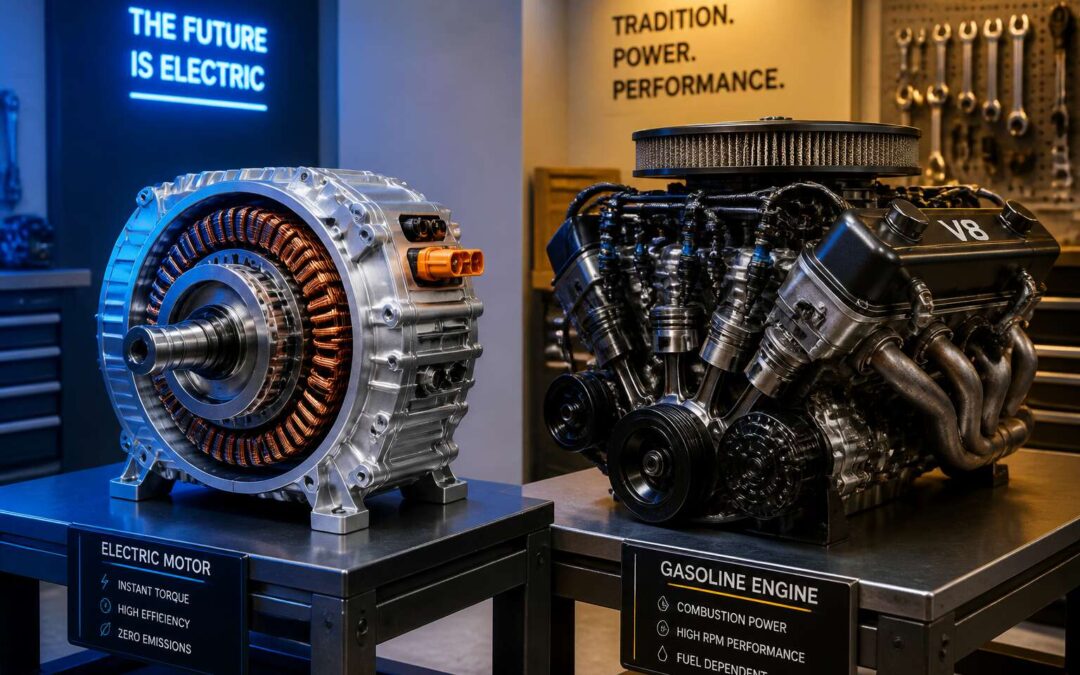
Performance And Efficiency Compared
Instant Torque And Acceleration
Step into any electric vehicle and press the pedal. The response is immediate, a surge that leaves petrol engines scrambling to catch up. That is instant torque, the electric motor’s defining trait. Petrol motors must build revs to reach their power band, creating that familiar lag before the kick. This difference transforms daily commutes in Johannesburg or Cape Town. If you ask are electric motors better than. gas, acceleration often settles the debate before you reach the next traffic light.
Consider what this means for overtaking on our national roads. An electric bakkie can pull into gaps a diesel would hesitate to take. The efficiency also shines in stop start urban traffic, where every launch wastes no energy spinning up a heavy flywheel.
- Full torque from zero rpm
- No gear changes interrupting progress
- Consistent power regardless of altitude
The numbers speak plainly, yet the feeling behind the wheel is what converts skeptics. You simply cannot replicate that electric immediacy with a combustion engine.
Power Delivery Curves
Petrol engines convert barely a quarter of their fuel into forward motion. The rest disappears as heat and noise. That fact repositions every power curve you have ever seen. An electric motor’s torque holds steady across a wide rev range, while a petrol engine’s builds slowly, peaks, then fades.
Altitude sharpens this reality. On the Highveld, petrol power drops by a fifth because oxygen is thin. Electric motors are indifferent, they deliver identical output in Johannesburg or at the coast. The question are electric motors better than. gas answers itself once you drive both at 1 500 meters.
- Electric motors convert about 90 percent of stored energy into motion
- Petrol engines convert roughly a quarter, the rest escapes as heat
- Fewer moving parts means fewer components to wear or fail
The efficiency gap accumulates quietly over a year of commuting. Less heat. Less wasted energy. Less maintenance. The electric power curve stays flat, which is the truthful measure of daily capability. That flatness makes the answer to are electric motors better than. gas an easy one.
Energy Conversion Efficiency In Real-World Driving
Consider a typical morning crawl along the M1. A petrol engine idles at every robot, converting fuel into heat and noise while going nowhere. An electric motor simply stops drawing power. That difference is not marginal; it is a clear difference in how energy behaves.
Regenerative braking recaptures the momentum that combustion engines waste as brake dust. In stop-start traffic, this recovered energy can extend range by a meaningful margin. The arithmetic is plain:
- Electric motors convert about 90 percent of stored energy into motion.
- Petrol engines convert roughly 25 percent.
- The remainder escapes as heat, noise, and vibration.
Are electric motors better than. gas when measured in real-world driving? The efficiency gap shows up in your monthly energy bill, not in a spec sheet. It is the difference between paying for motion and paying for the privilege of wasting fuel.
Regenerative Braking Benefits
Ask any Uber driver in Cape Town about brake pads and you will hear a price that stings. Regenerative braking changes that arithmetic. In an electric motor, deceleration becomes generation, capturing kinetic energy and returning it to the battery. This reduces wear on friction brakes, especially in Johannesburg’s stop-and-go traffic.
Efficiency appears on descents. On the N1 towards Pretoria, an electric vehicle glides downhill without riding brakes, converting gradient into stored range. I watched the gauge climb through Constantia Nek. For the question of are electric motors better than. gas, the answer is about wasted momentum versus captured momentum. Consider:
- Brake pads last longer in city driving.
- Descents add range instead of burning fuel.
- Passengers feel fewer jerky stops.
Total Cost Of Ownership Breakdown
Electricity Versus Fuel Price Volatility
I track energy costs with precision. In South Africa, the petrol price moves with Brent crude. Electricity follows Nersa’s approved tariff path. That difference determines are electric motors better than. gas.
Here is the monthly scenario:
- One litre of petrol now costs about R23, and it rose by R2 in a single quarter.
- One kilowatt hour of home electricity averages R2.50, and it holds steady for months.
Divide those numbers by vehicle efficiency. A gas car uses 0.15 litres per km. An electric car uses 0.18 kWh per km. You pay R3.45 per km on petrol versus R0.45 on electricity. Price jumps for fuel add R30 per fill-up. Electricity tariffs rarely spike that hard. Over 2000 km monthly, the annual difference exceeds R70,000. That is the total cost of ownership, laid bare.
Maintenance Savings And Frequency
The ledger of ownership often hides its heaviest weights in the shadows. For petrol vehicles, the service bay is a familiar haunt. Oil changes, spark plugs, belts, and filters arrive with a predictable rhythm, each visit a small tax on your time. Electric motors carry no such baggage. There is no exhaust system to corrode, no timing chain to snap.
Consider the regular maintenance savings with a battery electric vehicle. A petrol car might need a major service at 60,000 km, costing thousands of rand. Over five years, the parts and labour add up to a figure that makes you wince. The electric vehicle still has a cabin filter and wiper blades, but the motor itself asks for so little. Brake pads last longer, too. The regenerative system captures energy and slows the car, leaving the physical brakes to rest. In Johannesburg traffic, that matters.
Frequency tells its own story. The petrol car schedules a visit every 15,000 km or twice yearly. The electric car might only see a workshop for tyre rotations or software updates. This stark distance in upkeep changes the answer to whether are electric motors better than. gas for the average owner.
- Fewer moving parts in an electric motor means fewer failure points
- No transmission fluid to replace or clutch to wear out
- Annual service cost for a petrol car can be triple that of an electric equivalent
The warranty period often covers the entire life of an electric powertrain without a single unscheduled repair. My own calculation shows a petrol owner spending roughly two full weekends per year at a dealership. The electric driver reclaims those hours, converting maintenance downtime into kilometres travelled and quiet mornings. The cost of ownership breaks down clearly when you see the invoice, but the true weight is lifted from your shoulders, not just your wallet.
Battery Life And Replacement Expenses
The invoice reveals the answer. A petrol vehicle’s total cost of ownership includes fuel, servicing, and the steady decline of resale value. An electric vehicle shifts the ledger. The battery is the largest single line item, and its replacement expense once frightened buyers. Modern chemistries, however, outlast the chassis! Warranty terms in South Africa often cover eight years or 160,000 km.
- Battery replacement costs have fallen by nearly 80% over a decade.
- Most electric owners never pay that invoice at all.
- Resale value holds firmer once the market understands longevity.
The question of are electric motors better than. gas resolves itself when you count the full ownership period. The degradation curve flattens after the first year, and the arithmetic leans electric for anyone keeping the car past its warranty.
Government Incentives And Tax Credits
The purchase price still opens the conversation, and that upfront number often decides which way the ledger tilts. But the total cost of ownership breakdown reveals a different story after five years of payments and running costs. In South Africa, the initial gap between electric and combustion models remains real, yet government incentives and tax credits narrow it faster than most buyers expect.
The national strategy includes a few concrete levers:
When you stack those against the slow depreciation of a liquid fuel car, the question of are electric motors better than. gas starts answering itself. The arithmetic changes, not because of ideology, but because the state has decided to price the transition. That changes the ownership period as much as any engine specification.
Depreciation And Resale Value Dynamics
The depreciation curve is where ownership costs reveal their true weight. In South Africa, used electric vehicles have historically lost value faster than petrol models, but that pattern is now bending. As battery confidence grows, resale dynamics are shifting in ways few predicted three years ago.
The total cost of ownership breakdown no longer punishes the early electric adopter. Consider what stabilises residual worth:
- Battery health certificates now standard in private sales
- Fuel price volatility driving sustained used demand
- Growing ride share fleet purchases of pre owned EVs
These forces suggest the question of are electric motors better than. gas may soon be answered by the secondhand market before the showroom floor.
Environmental Footprint Assessment
Tailpipe Emissions And Air Quality
Few things clear a city street faster than a throaty V8, but that rumble has a downside. When we ask are electric motors better than. gas, the tailpipe comparison seems straightforward. Electric vehicles produce zero local exhaust, so pedestrians in Johannesburg no longer taste diesel fumes. That particulate matter, which contributes to asthma and grimy buildings, is simply absent.
However, the environmental footprint assessment gets murkier when you trace electricity to its source. South Africa’s grid relies heavily on coal, so an EV is essentially a coal-powered vehicle with extra steps. Still, electric drivetrains avoid nitrogen oxides and volatile organic compounds that petrol engines emit. The air quality improvement is tangible where people breathe:
- Zero sulphur dioxide from the tailpipe
- No benzene or toluene leakage
- Lower carbon monoxide near intersections
Thus, the immediate respiratory benefit is undeniable.
Manufacturing Environmental Costs
Manufacturing an electric drivetrain begins with minerals extracted from the earth. Cobalt, lithium, and nickel carry a heavy environmental price. Coal powered smelters and long shipping routes add emissions before the first kilometre is driven. For South African buyers, the answer to are electric motors better than. gas depends on where the line is drawn.
The gas motor assembly line is comparatively light. Cast iron blocks and aluminium heads require energy, but the supply chain is established and local. The battery pack requires refineries and chemical plants scattered across multiple continents.
- Lithium brine evaporation consumes vast water resources
- Nickel sulphate production releases sulphur dioxide
- Cobalt mining disturbs sensitive ecosystems
These costs are one time burdens. A petrol engine pays its manufacturing debt continuously through fuel production and combustion. That ongoing cycle shapes whether are electric motors better than. gas for a household watching its environmental impact.
Battery Disposal, Recycling, And Second-Life Use
Battery afterlife shifts the footprint. A pack with 70% remaining capacity still feeds a solar home, sparing it from grid coal. That second life matters! Recycling, while improving, still consumes energy and acid. Pyrometallurgical furnaces and leaching baths are not clean, but they beat virgin extraction.
Consider what a retired EV battery can do:
- Store daytime solar for evening use
- Back up a clinic during load-shedding
- Stabilise a small industrial microgrid
South Africa lacks a mature recycling pipeline, so many packs wait. The answer to are electric motors better than. gas depends on whether those packs become assets or hazards. If they sit indefinitely, the environmental debt compounds.
Noise Pollution Reduction
Ever heard a V8 roar at 6am? That’s not power, that’s acoustic vandalism. When weighing are electric motors better than. gas, the environmental footprint assessment often ignores decibels. Noise pollution isn’t just annoying, it stresses humans and wildlife. EVs whisper. The loudest thing in an electric bakkie might be the tyre tread on tar. That silence is a public health win. In cities like Joburg, traffic noise drops meaningfully when delivery fleets go electric. Consider the quiet chain:
- Residential streets calm down
- Birds and dogs adjust their alarms
- Night-time deliveries become possible
Compatibility With Renewable Energy Sources
South Africa’s grid remains coal-heavy, so the environmental footprint assessment of an electric motor shifts depending on where you plug in. But compatibility with renewable energy sources changes the equation. Solar and wind capacity is expanding across the Karoo and Northern Cape, and that reshapes how we answer are electric motors better than. gas.
When an EV charges from a home solar array, marginal emissions approach zero. A petrol bakkie cannot do that. It remains tethered to refining and fuel transport. The grid will decarbonise. A fuel tank will not.
The assessment also includes:
- Time-of-use tariffs that push charging into midday solar peaks
- Bidirectional charging that lets fleets sell power back during evening peaks
That flexibility gives electric drivetrains a structural advantage in a country with among the highest solar irradiation on Earth. The gas alternative cannot participate in that loop. On the question of are electric motors better than. gas, renewable energy compatibility alone offers a compelling answer.
Lifecycle Analysis Across Decades
Lifecycle analysis stretches beyond the first fill-up. It follows a vehicle for fifteen or twenty years, measuring the carbon debt of raw materials, the energy consumed during operation, and the final recovery or disposal of parts. That long view reshapes the question are electric motors better than. gas.
In South Africa, an electric motor begins with a heavier environmental load because of battery production and a coal heavy grid. But the ledger moves. Every gigawatt of wind added in the Eastern Cape or solar on a Johannesburg warehouse roof improves the arithmetic. A petrol engine’s footprint is static. It cannot shed the refinery and transport emissions that were fixed on the day it was built.
That asymmetry is the core finding. An electric motor improves as the grid does. Gasoline does not.
Practicability And Driving Experience
Range Limitations And Charging Infrastructure
Living in Johannesburg, the commute poses the question of are electric motors better than. gas. The silent glide from Sandton to Midrand feels effortless, but range anxiety never disappears. Most EVs deliver 350 to 450 kilometres per charge, which sounds sufficient until you factor in school runs or an unexpected client visit.
Charging infrastructure in South Africa remains patchy. Malls in Cape Town boast fast chargers, but smaller towns along the N1 offer only a three-pin socket. The hunt for a working charger, especially during loadshedding, turns a simple errand into a puzzle.
- Home charging offers genuine convenience
- Long trips require route planning around DC fast chargers
- Workplace charging remains inconsistent
Driving an EV changes your relationship with time. You charge opportunistically, not waiting for an empty tank. That habit shifts the debate around are electric motors better than. gas from a technical question to one about daily rhythms.
Cold Weather Impact On Performance
Winter mornings in Johannesburg can drop below freezing in July, and that cold exposes a weakness of electric powertrains. Battery chemistry slows when the mercury falls. Regenerative braking weakens, and range can shrink by 20 percent on a bitter Highveld day. The cabin heater draws current directly from the battery, a harsh trade when your children need warmth on the school run. I have watched displayed range drop noticeably before the car even moves.
Some EVs use heat pumps instead of resistive heaters, which reduces the drain. Preconditioning while plugged in helps immensely. A garage makes more difference than you might expect in this debate over are electric motors better than. gas.
- Keep the cabin cooler and rely on seat warmers when driving alone
- Schedule departure charging to warm the battery before you leave
- Expect extra charging stops during winter trips to the Drakensberg
Towing And Payload Capabilities
Towing a horse trailer through the Karoo is a different covenant when the powertrain is electric. The torque exists, but the range bleeds away with every kilogram behind you. I once hauled a broken down bakkie twenty kilometers with an EV. The battery gauge dropped fast. Gas vehicles strain but do not count the weight with such precision.
Batteries add mass, so payload capacity shrinks. A petrol double cab swallows cement bags without complaint; an electric one sacrifices that margin to the pack below.
- Check the GVM rating before towing
- Plan for a 30 percent range reduction when towing
- Weigh the trailer
For a farmer moving feed or a family dragging a caravan, this calculus matters. Are electric motors better than. gas? Ask again with a loaded hitch!
Vehicle Selection And Model Availability
The electric motor greets you with silence, and that silence is the first surprise. In Johannesburg traffic, the cabin stays quiet, and acceleration obeys readily. But practicability depends on your route. A quick trip from Sandton to Pretoria is effortless. A cross border trek into Mozambique requires planning that no petrol driver ever considers.
Model availability in South Africa is growing, yet the choice remains limited:
- BYD Atto 3 for urban commuters
- Volvo EX30 for premium buyers
- GWM Ora for budget conscious families
Each electric model demands a certain personality. You must embrace charging schedules and route forethought. The question of are electric motors better than. gas only resolves when you find a car that matches your daily reality.
Technological Advancements And Future Outlook
Over-The-Air Software Updates
Over-the-air software updates are reshaping how we judge vehicles. While many drivers focus on hardware, I see the real shift happening in code. A single update can sharpen throttle response, adjust battery charging curves, or even improve range estimates. This means the car you buy today is not the same car you drive a year from now. Gasoline engines lack this adaptive layer; their performance is fixed at the factory.
- Refined battery thermal management for hot South African summers
- Improved regenerative braking efficiency in stop-start traffic
- Faster charging algorithms that protect cell longevity
For owners asking are electric motors better than gas, this evolution matters. The answer keeps changing, and over-the-air updates are why!
Autonomous Driving Integration
Autonomous driving is the technological frontier where electric drivetrains hold a decisive edge, especially on South African roads. The chaotic flow of minibus taxis and the sudden weather shifts on the Highveld create a severe test for self-learning algorithms. Electric motors respond with a latency that mechanical systems cannot match.
Consider the future outlook for fleet operators in Johannesburg. I am watching this shift closely, because electric control allows safety maneuvers to execute exactly as coded, without combustion lag. This is where the question of are electric motors better than. gas becomes a matter of software architecture.
As autonomous systems evolve, they rely on:
- High-voltage architectures to power advanced lidar arrays
- Instant, silent actuation for pedestrian-aware systems
- Integrated data loops that adjust driving style to local congestion
Gasoline engines hold no such roadmap. Their mechanical constraints become the limiting factor for autonomy itself.
Solid-State Batteries And Energy Density
A paradox sits at the heart of modern motoring: the fuel tank is a century old, yet its replacement is still waiting for a chemical breakthrough. Solid-state batteries are that breakthrough. Their energy density could reach 500 watt-hours per kilogram, double today’s best cells. For South Africans, the N3 to Durban becomes a single charge.
The shift relies on replacing liquid electrolytes with ceramic or polymer solids. This raises the ceiling on energy storage without adding weight. It also reduces fire risk, a quiet concern in our summer heat. The question of are electric motors better than. gas grows clearer as these cells move from laboratory to production line.
- Lower battery weight improves handling on gravel roads
- Higher density supports roof racks and towing loads
Early solid-state prototypes have survived 10,000 charging cycles. That longevity addresses the secondhand market’s biggest anxiety. When a battery outlasts the body of a bakkie, the answer to are electric motors better than. gas becomes almost rhetorical. The future is not a vague promise; it is a stack of ceramic layers under a charging floor in Midrand.
Ultra-Fast Charging Innovations
Fast charging is not about eliminating the wait; it is about making the wait feel like a choice. Ultra fast charging innovations now use 800 volt architecture to add 300 kilometres of range in the time it takes to order a coffee. That makes the question of are electric motors better than. gas a matter of personal scheduling, not national infrastructure.
Charging stations pre condition batteries before you plug in, using predictive thermal management. This shortens the peak charging phase and spares the pack from stress. For South Africans, the N1 between Johannesburg and Cape Town becomes a series of polite pauses rather than a test of endurance.
- Battery pre conditioning reduces peak charging times
- Dynamic load sharing keeps station costs predictable
The faster we charge, the more we notice charging manners. Who occupies a rapid bay without needing it? The technology answers, but etiquette remains.
Grid Load Management And Smart Charging
South Africa’s grid has limited headroom during evening peaks. Smart charging uses live tariff signals to spread demand across the night. When cars communicate with the grid, they wait for cheaper, cleaner moments to draw power. This is where are electric motors better than. gas depends on shared infrastructure as much as individual driving habits.
Load shifting can reshape a neighbourhood in Johannesburg:
– Chargers pause when demand spikes and resume when supply eases.
– Solar homes export surplus midday power to charge nearby vehicles.
– Municipalities avoid substation upgrades by staggering charge sessions.
The future outlook treats every car battery as a temporary storage node. The grid becomes a partner rather than a passive supplier. That coordination is the quiet revolution. For South Africans, the answer to are electric motors better than. gas may soon depend on how well we manage the watts we already have.