
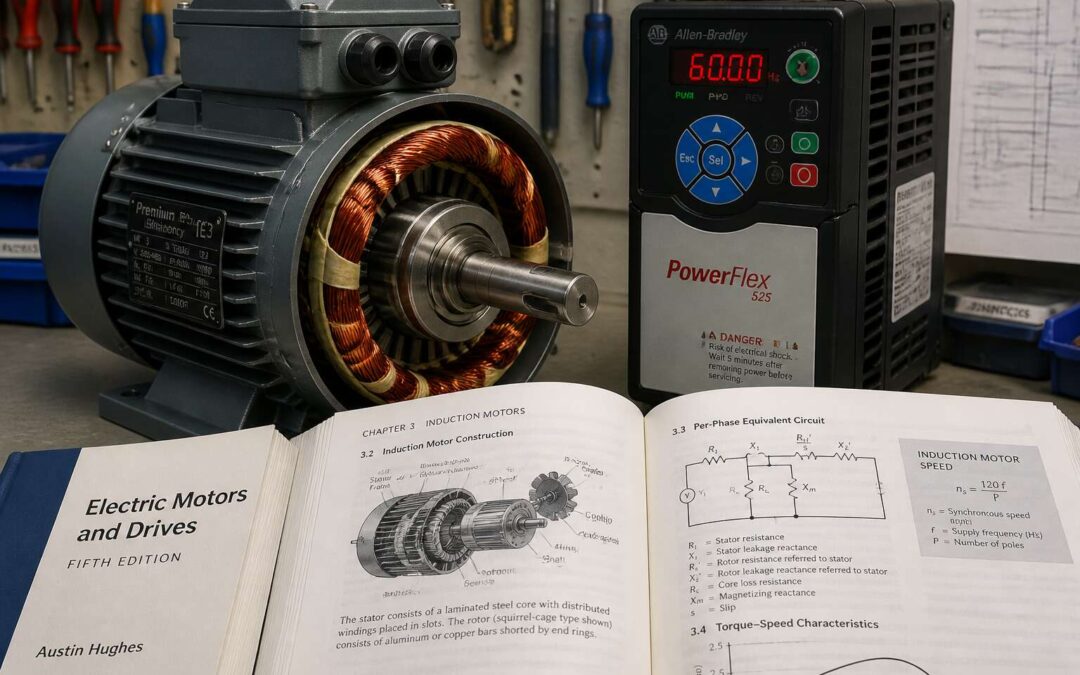
What’s New in the 5th Edition
Updated Content on Modern Power Electronics
The 5th edition introduces significant updates to power electronics, reflecting the rapid evolution of converter technologies. I was especially impressed by the expanded coverage of wide-bandgap semiconductors, which are fundamentally changing how we approach efficiency in variable speed drives.
The updated content on modern power electronics includes:
- New material on silicon carbide and gallium nitride devices
- Revised explanations of multilevel converters for medium voltage applications
- Enhanced coverage of regenerative drive systems
These additions matter for South African engineers facing energy costs and grid stability concerns. The text now addresses harmonic mitigation and power quality with directness that previous editions lacked. For anyone working through the electric motors and drives 5th edition, this chapter alone justifies the upgrade, offering clarity on subjects once scattered across multiple sections.
New Focus on Energy Efficiency and Sustainability
The 5th edition directs attention to the energy ledger beyond the converter cabinet. Motor efficiency classes IE4 and IE5 receive dedicated coverage, including guidance for retrofitting older installations across South African mining and industrial sites. The electric motors and drives 5th edition walks through life cycle costing, showing how the purchase price becomes less significant against a decade of electricity bills.
New chapters examine duty cycles and their effect on actual energy draw. This matters for pump and conveyor applications where motors rarely run at full load. The text also covers:
- Standards alignment with SANS and IEC efficiency ratings
- Methods for quantifying energy savings from variable speed operation
- System-level design for lower carbon footprints
The electric motors and drives 5th edition frames sustainability as an engineering requirement rather than an abstract ideal. South African engineers gain practical tools to trim consumption without sacrificing performance.
Expanded Coverage of Permanent Magnet and Specialty Motors
The days of the induction motor as the default option are fading. The electric motors and drives 5th edition expands its coverage of permanent magnet and specialty motors, giving South African engineers a closer look at technologies that now appear in conveyors, mills, and compressor trains. Permanent magnet synchronous machines earn their place where torque density and compact form factors outweigh initial cost.
The text also examines synchronous reluctance motors for pump and fan retrofits. Switched reluctance and dual stator designs get attention for fault tolerance in harsh mining environments.
Specific additions include:
- Selection criteria for permanent magnet versus induction machines
- Rotor construction differences and maintenance implications
- Integration with existing drive cabinets and control loops
The electric motors and drives 5th edition treats these machines as practical options, not academic exercises. That matters for plant engineers planning replacements over the next decade!
Revised Applications for Electric Vehicles and Renewable Energy
The updated book reworks its treatment of traction drives for electric vehicles. Engineers at South African assembly plants will find new guidance on inverter duty cycles, thermal management, and regenerative braking logic. The electric motors and drives 5th edition shifts from theoretical motor design toward system level integration.
For renewable energy, the book addresses the demands of solar water pumps and wind turbine pitch control. These applications expose machines to variable torque and rapid reversals. The authors spend real pages on grid feeding, islanding detection, and the synchronous condensers that stabilise weak municipal grids. This marks a clear advance over older editions! Specific updates cover:
- Drive sizing for lithium battery voltage sag
- Control loop tuning for bidirectional power flow
- Harmonic filtering for converter fed wind generators
Additional Learning Resources and Worked Examples
What surprised me most about the electric motors and drives 5th edition is how the authors rebuilt the learning apparatus around the text. The worked examples no longer stop at the answer. They now walk through the assumptions, the torque calculations, and the thermal checks that engineers in Johannesburg or Durban would actually run before commissioning a machine.
Additional resources include a companion website with downloadable simulation files. These are not generic demos. They model real conditions like voltage dips on Eskom’s grid or harmonic distortion from variable speed drives. The worked examples use SI units throughout and reference South African wiring standards where relevant.
- Step by step solutions for induction motor starting methods
- Detailed case studies on drive commissioning failures
- Parameter estimation exercises using nameplate data
For a self taught technician or a university lecturer, the electric motors and drives 5th edition offers something rare: a textbook that respects your time while demanding your attention. That balance is exactly what makes it worth the shelf space.
Alignment with Current Industry Standards and Regulations
“Another new clause in the South African grid code landed in 2023, and the electric motors and drives 5th edition tracks those shifts with uncommon precision. The authors aligned every chapter to SANS 60146 and the latest IEC 60034 revisions, so the torque calculations you run in Durban match the compliance paperwork you file in Johannesburg. That alignment matters when a variable speed drive trips during a voltage dip or when a harmonic filter fails an Eskom grid code audit.
The 5th edition also reworks its protection coordination sections around updated regulations for motor thermal overloads and fault current ratings. This means the textbook now covers:
- Compliance checks for low voltage motor starters per SANS 60947
- Harmonic emission limits that match NRS 048 requirements
- Earth leakage and earthing strategies for hazardous area drives
For electrical engineers who spend more time with compliance officers than with motor theory, the electric motors and drives 5th edition tells you exactly what to check before you sign a commissioning report. It feels like the authors finally read the South African wiring standards themselves.
Foundational Principles of Electric Motors and Drives
Understanding Electromagnetic Principles and Magnetic Circuits
One fact separates engineers who merely operate motors from those who truly understand them: the flux path determines everything. The electric motors and drives 5th edition starts with this foundational truth by teaching readers to visualise magnetic circuits before touching a single equation. Reluctance, magnetomotive force, and hysteresis become working tools, not abstract terms.
- Flux density drives torque density.
- Air gap length dominates reluctance.
- Core saturation limits performance.
Real machines live and die by leakage inductance and eddy current losses. The text grounds every formula in physical reality, which is why engineers repeatedly turn back to these pages.
Torque-Speed Characteristics and Operating Curves
The torque-speed curve decides whether a machine hauls a load from rest, holds it at speed, or stalls under strain. The electric motors and drives 5th edition treats this curve as a practical tool, not a theoretical illustration. Readers learn to trace how starting torque, pull-up torque, and breakdown torque shift with rotor resistance and supply voltage.
Operating curves extend the story beyond motion. Efficiency, power factor, and current all change with load, and the text maps each one against speed and torque. That mapping matters for South African industries running conveyors, pumps, and winches where the wrong operating point wastes energy. We have seen motors run beautifully at nameplate speed yet fail under real duty.
The electric motors and drives 5th edition breaks down the families of machines:
- DC shunt motors deliver steady speed but modest starting torque.
- DC series motors offer high starting torque and a dangerous runaway tendency.
- Induction motors balance robustness with a drooping speed curve.
Reading these curves with confidence separates informed selection from guesswork.
Motor Classifications and Modes of Operation
Motors eat electricity. In South African industry, they account for most of a plant’s consumption. The electric motors and drives 5th edition begins with classification because that decision shapes everything downstream. Machines split first by supply type, then by construction, then by intended duty.
Modes of operation carry their own labels. Continuous duty (S1) means steady load at thermal equilibrium. Intermittent duty (S2 and S3) permits cooling between runs. Regenerative braking reverses the machine’s role, turning it into a generator that feeds energy back into the supply.
- Separately excited DC motors for precise torque control
- Shunt, series, and compound configurations for varied load demands
- Squirrel cage and wound rotor induction machines for industrial workhorses
Each classification carries real consequences. Over-specify a continuous motor for intermittent duty and you waste capital. Under-specify it and the windings cook. We see that trade-off daily in plants across the country. The electric motors and drives 5th edition maps these choices plainly.
The Role of Power Electronics in Variable Speed Drives
In South Africa, industrial motors consume over 60% of the grid’s electricity. The drive determines how much of that power becomes useful work. A motor’s torque emerges from magnetic fields interacting with current, but the drive controls that interaction. Power electronics changed everything! By switching voltage and frequency at high speed, inverters shape the supply to match the load’s exact demand. This is where variable speed drives prove their value.
Consider a conveyor in a Mpumalanga coal plant. Without a drive, the motor runs at fixed speed, wasting energy whenever the belt runs light. I have seen that waste firsthand. With a drive, the motor slows, and the savings appear on the monthly bill. The electric motors and drives 5th edition explains these principles with clarity.
1. Torque production depends on flux and armature current.
2. Speed control requires adjusting frequency or voltage.
3. Regenerative operation returns energy to the grid.
Efficiency, Losses, and Thermal Management in Electric Machines
Every joule that becomes heat instead of motion is a quiet failure. Efficiency in electric machines is the ratio of useful mechanical power to electrical input, but the untold story lives in losses. Copper losses from resistance, iron losses from magnetic cycling, and mechanical losses from friction all degrade performance. The electric motors and drives 5th edition explains these mechanisms without fluff!
Thermal management decides whether a motor survives or silently degrades. Heat ages insulation, alters magnetic properties, and shortens bearing life. In South Africa, ambient temperatures above 40°C compound the challenge!
- Copper losses scale with current squared
- Iron losses depend on frequency and flux density
- Mechanical losses grow with shaft speed
Knowing where energy disappears lets you match a drive to the motor for minimal waste. The electric motors and drives 5th edition provides thermal models and derating guidance for local conditions.
In-Depth Review of Motor Types and Drive Systems
DC Motors and Their Control Strategies
Nearly a third of industrial variable speed drives in South Africa still use DC motors. That number rarely fails to surprise modern engineers. The electric motors and drives 5th edition offers a detailed review of these systems, with special attention to how we command their speed and torque.
Control strategies split into three practical categories:
- Armature voltage control for constant torque below base speed.
- Field weakening for constant power above base speed.
- Pulse width modulation for precise digital current control.
Each strategy changes the motor’s dynamic response. Getting this wrong leads to overheating or erratic behavior. The new edition explains these tradeoffs without the usual academic fog.
Induction Motors and Variable Frequency Drives
Induction motors dominate the South African landscape, from mines to sugar mills. Their simple construction hides a complex control problem. The electric motors and drives 5th edition breaks down how variable frequency drives adjust both voltage and frequency to match load demands.
Three elements define a modern VFD:
- Rectifier stage that converts AC to DC.
- DC bus that smooths the power flow.
- Inverter stage that produces adjustable frequency output.
The edition walks through each stage with practical examples, showing why vector control outperforms scalar control for dynamic applications. This matters when a crusher stalls or a conveyor surges.
Synchronous Motors and Permanent Magnet Motors
In South African mines, a synchronous motor holds a crusher at exact speed while the load swings wildly. That precision comes at a cost. The electric motors and drives 5th edition explains how synchronous machines need different starting techniques and excitation arrangements than induction motors. Permanent magnet motors simplify the rotor by replacing windings with magnets, yet they bring their own drive complications.
Consider what the 5th edition clarifies about these systems:
- Field oriented control for permanent magnet synchronous motors
- Sensorless operation using back EMF estimation
- Demagnetisation risks under fault conditions
The drive system chapters compare position feedback requirements across motor types. This matters when engineers evaluate retrofits for ageing plants. I have watched plant managers wrestle with these choices, and the guidance in this edition resolves the confusion around synchronous and permanent magnet options.
Stepper and Servo Motors for Precision Applications
A positioning error of half a millimetre can scrap an entire batch of machined parts. In South African manufacturing, packaging lines and CNC machines depend on stepper and servo motors to hold position without constant feedback. The electric motors and drives 5th edition breaks down when open loop stepper operation is acceptable and when closed loop servo control becomes non negotiable. I have watched plants burn hours chasing position errors from the wrong choice here.
Steppers excel at low cost positioning. Servos win where torque must hold against disturbance. Consider what the text clarifies about tuning and stability:
- Stepper resonance and damping techniques
- Servo loop tuning for load inertia mismatch
- Encoder resolution requirements for both systems
The electric motors and drives 5th edition explains why stepper motors lose torque at high speed while servo drives maintain performance through field weakening. Engineers evaluating retrofits in older plants rely on this edition for the comparison.
Drive System Components and Their Integration
I once watched a single failed DC link capacitor halt a packaging line in Johannesburg for an entire shift. The drive components around the motor determine real world reliability.
The electric motors and drives 5th edition maps the full chain of integration, from input rectifier and DC bus to inverter switching and control logic. It shows how encoder wiring, brake resistors, and earth bonding influence operation. The text presents the drive as a single system, not a collection of spare parts.
- Rectifier and DC bus sizing
- Inverter gate driver circuits
- Feedback device integration
- Protection and EMC filtering
Understanding these interactions helps engineers trace phantom faults that mimic motor failure.
Comparative Analysis of Drive Technologies and Topologies
Comparing drive technologies in the electric motors and drives 5th edition shows how topology decisions affect torque response, harmonic content, and energy recovery. Scalar control remains useful, but field oriented control and direct torque control change how engineers manage instantaneous torque. Each approach carries trade-offs in switching frequency, sensor feedback, and tuning complexity.
The division between voltage source and current source inverters defines system behaviour. Voltage source inverters dominate industrial use, while current source inverters provide inherent short circuit protection. Regenerative topologies are no longer optional in South African industry, where electricity tariffs push payback calculations into every design review.
- Two level inverters for simplicity and lower cost
- Multilevel inverters for reduced harmonic distortion
- Matrix converters for direct AC to AC conversion
These distinctions matter on a packaging line in Johannesburg or a mining conveyor near Rustenburg. Grid disturbances, motor cable lengths, and bearing currents all trace back to the chosen topology. The text forces the reader to connect those physical effects to their root causes.
Practical Applications and Selection Strategies
Industrial Machinery, Conveyors, and Automation
When selecting motors for industrial machinery, engineers face decisions that go beyond wattage and speed. Conveyor systems demand reliable starting torque, while automation cells require precise positioning. I find the electric motors and drives 5th edition offers practical frameworks for matching drive topologies to application profiles. It highlights how inertia ratios, duty cycles, and ambient conditions dictate choices. A mine conveyor running 24 hours demands a robust induction motor with a variable frequency drive, whereas a packaging robot benefits from servo motors with high dynamic response. The text also addresses thermal derating at altitude, which matters for South African highveld installations. Evaluate load characteristics first, then drive capabilities. Common scenarios include:
– Continuous duty pumps requiring constant torque
– Intermittent duty hoists needing peak torque
– Positioning drives where encoder resolution is critical
This practical lens turns selection into a systematic process.
HVAC, Pumping, and Fan Systems
In South Africa’s sprawling industrial corridors, HVAC systems consume a significant portion of operational energy. The electric motors and drives 5th edition frames selection around load profiles rather than nominal ratings. Pumping systems often operate at variable flow rates. A fixed-speed motor with throttling valves wastes power. Instead, engineers can pair centrifugal pumps with variable frequency drives to match output to demand. Fan systems present similar challenges, especially in cooling towers where ambient temperatures fluctuate.
Consider these selection criteria for HVAC installations:
- Assess the system’s duty cycle across seasons.
- Verify that the drive’s overload capability aligns with start-up torque.
- Evaluate harmonic distortion from multiple drives on a shared network.
Altitude also shifts performance. Johannesburg’s 1,700 meters reduces air density, altering fan curves and motor cooling. The textbook’s derating tables prevent undersized equipment failures.
Electric Vehicles and Traction Drives
Electric vehicles are rewriting the rules of traction drive selection in South Africa, where load profiles differ sharply from conventional industrial applications. The electric motors and drives 5th edition addresses these shifts with detailed guidance on matching inverter duty cycles to urban driving patterns. Minibus taxis, for example, demand high starting torque for frequent stops, while highway fleets prioritise sustained efficiency at cruising speed.
Battery voltage platforms also complicate the picture. Lower voltage systems ease insulation requirements but push current limits. Higher voltage architectures reduce conductor losses yet strain inverter switching components. The handbook’s comparison tables help engineers weigh these trade offs against local temperature extremes.
- Map typical route gradients to continuous torque requirements.
- Assess regenerative braking recovery in congested corridors.
- Confirm cooling system performance at high ambient temperatures.
Reference tables in the electric motors and drives 5th edition provide derating factors for altitude and thermal conditions, preventing premature failures in traction systems.
Renewable Energy Systems and Grid Interactions
South Africa’s grid now carries over 6 gigawatts of embedded solar, yet the motors that track sun and cool inverters face a paradox. They must perform during erratic irradiance while feeding a network prone to voltage swings. The electric motors and drives 5th edition examines this reality with specific guidance on selection for renewable assets.
When I consult for wind farms in the Karoo or solar plants in the Free State, the conversation turns to grid code compliance. Motors and drives must handle reactive power demands, harmonic filtering, and rapid ramp rates. The handbook dissects these interactions, showing how variable speed drives can offer synchronous condenser duty without additional hardware.
- Consider anti-islanding protection for inverter fed motors.
- Confirm low voltage ride through capabilities for grid stability.
- Match thermal class to ambient profiles at high altitude sites.
This insight from electric motors and drives 5th edition prevents costly missteps when integrating renewable generation into municipal networks.
Selecting the Right Motor and Drive Architecture
Selecting the right motor and drive architecture begins with the load profile, not the nameplate. In South African plants, I routinely encounter mismatched torque characteristics that lead to premature winding failures. The electric motors and drives 5th edition offers a practical framework for aligning drive topologies with mechanical demands, saving both capital and maintenance budgets.
Constant torque loads require different variable frequency drive configurations than variable torque loads. The handbook clarifies these distinctions through real world examples that translate directly to plant floor decisions.
- Measure starting torque requirements before choosing a drive
- Verify overload capacity against peak demand cycles
- Account for regenerative braking on overhauling loads
This structured approach reduces downtime and extends equipment life across demanding operating environments.
Sizing, Performance Verification, and Economic Justification
Sizing a drive is an exercise in restraint. The electric motors and drives 5th edition forces you to confront the gap between nameplate promise and shaft reality. I have watched engineers oversize by thirty percent, believing safety factors protect against ignorance. They do not. They merely shift the failure point elsewhere.
Performance verification starts with thermography under full load, not a multimeter reading at the panel. Measure current harmonics. Log bearing temperatures across a full shift cycle. The data will betray assumptions.
- Base sizing on locked rotor current, not running current
- Verify thermal limits against ambient extremes
- Cost out the entire drive train, including cooling and cabling
Economic justification follows the evidence. If your payback calculation ignores maintenance intervals, it is fiction. The electric motors and drives 5th edition gives you the structured method to compare total lifecycle costs, then defend the budget with numbers that survive scrutiny.
Control, Maintenance, and Modern Trends
Closed-Loop Control and Feedback System Design
Closed-loop control changes how an electric motor behaves under stress. Without feedback, the machine cannot correct for load shifts or volatile supply voltage. The electric motors and drives 5th edition breaks down the feedback architectures that keep modern systems stable. Encoders, resolvers, and current sensors feed live data to the drive, which adjusts speed and torque within milliseconds. South African plants, where grid stability is not guaranteed, benefit directly from this precision.
Maintenance takes on a new character with feedback in place. Stator current analysis and vibration monitoring reveal bearing wear and insulation stress before failures occur. Modern trends favour predictive maintenance, where the drive itself flags component deterioration. The electric motors and drives 5th edition shows how closed-loop design enables these diagnostics without forcing a full control system overhaul.
- Encoder interfaces for positional accuracy
- Sensorless vector control for induction motors
- Diagnostic output for condition monitoring
The result is less unplanned downtime and longer service life.
Condition Monitoring and Fault Diagnosis
A motor that cannot complain will cost you a week of production. Control loops need more than a good start. Offsets drift and components age. The electric motors and drives 5th edition covers adaptive tuning and periodic recalibration, which keeps a drive honest over time.
Maintenance in South African plants often happens during scheduled shutdowns. Failures rarely respect that schedule. Thermal imaging and insulation resistance testing catch deterioration that vibration analysis can miss.
Modern condition monitoring has moved toward fault diagnosis before failure. Waveform capture and motor current signature analysis run continuously inside many modern drives. Some systems log events and flag emerging patterns.
A practical monitoring plan includes:
1. Insulation resistance trending
2. Thermal imaging of terminal boxes
3. Current signature analysis for rotor faults
These tools give maintenance teams exact targets. In my experience, that turns maintenance into a measured discipline. The electric motors and drives 5th edition presents these methods as a structured fault management system.
Preventive Maintenance and Lifecycle Management
Control loops lose their edge as components age. A drive that ran perfectly at commissioning can develop offsets within months. Scheduled recalibration and adaptive tuning are not optional. They are the backbone of lifecycle management.
Modern preventive maintenance looks beyond fixed intervals. It uses operational data to predict wear before it disrupts production. This approach extends motor life and reduces unplanned downtime.
- Regular control loop performance reviews
- Preventive replacement of aging components
- Documentation of maintenance trends
The electric motors and drives 5th edition frames these practices as core skills for engineers who prioritize reliability over simple repairs.
Integration with Industry 4.0 and IoT Platforms
The silence of a failing drive is rarely absolute. It hums at frequencies only sensors detect. Industry 4.0 platforms capture these signals and translate them into actionable intelligence. IoT sensors monitor vibration, temperature, and current draw across every axis of operation. The data flows into dashboards that expose drift before it becomes a fault.
Control loops refine themselves continuously against this live stream. Maintenance shifts from scheduled inspection to predictive intervention. In South African manufacturing, where load shedding interrupts production rhythms, this visibility matters. The electric motors and drives 5th edition documents these integration patterns with clarity.
- Real time performance telemetry from drive networks
- Automated fault logging and root cause analysis
- Cloud based asset registers linked to maintenance calendars
This convergence changes how engineers approach both control and upkeep.
Advanced Energy-Saving Techniques and Regenerative Driving
Regenerative driving transforms kinetic energy into usable power rather than dissipating it as heat. In South African facilities, where energy costs keep climbing, this recovery cuts operational expenditure substantially. The electric motors and drives 5th edition explains how modern drives manage bidirectional power flow, returning energy to the grid or sharing it across a DC bus.
Control algorithms now adjust torque and speed in real time, and maintenance benefits are tangible. Regenerative operation lowers brake wear and extends bearing life. I’ve seen plants reduce their resistor bank maintenance by half after switching to shared DC bus architectures.
- Dynamic brake resistor sizing for partial regeneration
- Active front end converters for grid feedback
- Energy storage integration for load leveling
Engineers using the electric motors and drives 5th edition gain practical guidance for implementing these techniques without reworking their entire plant architecture.
Future Trends in Motor Drive Technology and Digitalization
Control architectures now rely on distributed intelligence rather than centralised logic. The electric motors and drives 5th edition details how fieldbus protocols and real-time ethernet enable this shift. South African operations can retrofit these systems without replacing entire motor fleets.
Maintenance teams are moving from reactive schedules to condition-based strategies. Thermal imaging, vibration signatures, and current analysis reveal early signs of insulation breakdown or bearing wear. I have watched plants extend motor life by years using these diagnostic inputs. The results speak for themselves!
Digitalization is reshaping drive integration across mining, agriculture, and manufacturing.
- Edge processors handle predictive maintenance locally
- Digital twins simulate motor behaviour under load
- Cloud dashboards aggregate fleet performance data
The electric motors and drives 5th edition provides the framework for implementing these trends with minimal disruption.