
Unpacking the Definition of an Electric Motor
Think of a simple bicycle. You pedal, the chain turns, and the wheels move. Now, remove the rider. How do you get motion without the pedaling? That is the fundamental problem an electric motor solves. It is a machine that converts electrical energy into mechanical energy, creating rotational force from a power source.
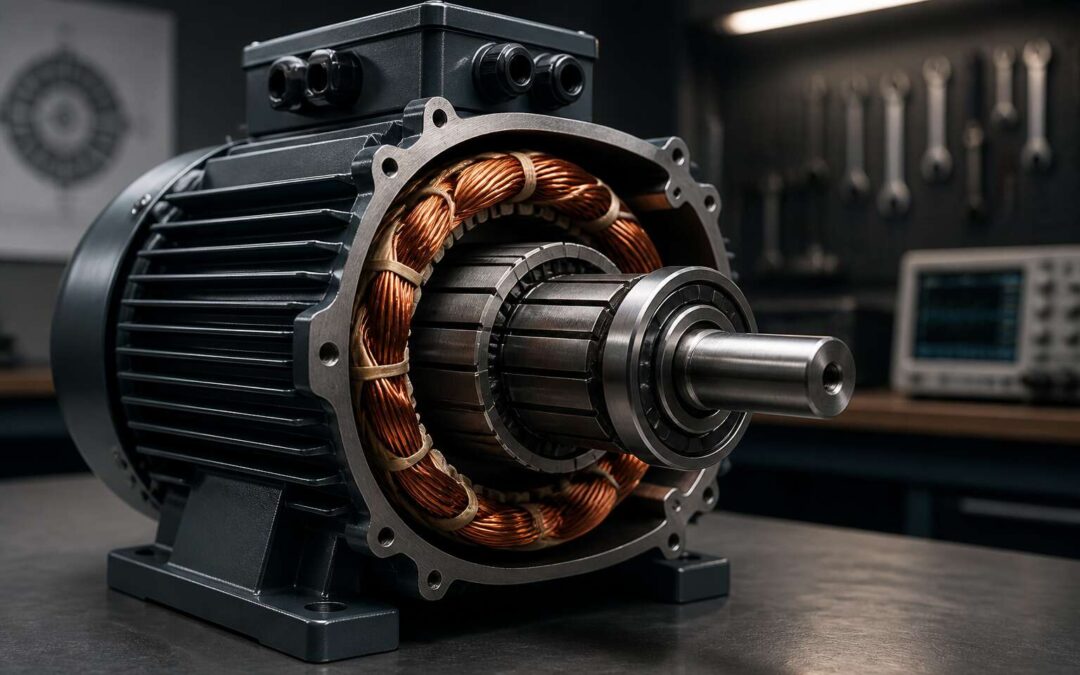
Electric motors meaning can feel abstract until you picture the components working together. The essential parts are an armature and a stator, a rotor and a magnetic field. Electrical current passes through the coils, generating a force that spins the rotor. That spin is your output, the mechanical work.
– It powers the fan over your head.
– It raises the window in your car.
– It starts the pump in your kettle.
The physical size changes, but the principle remains identical. The quiet hum in your refrigerator is a testament to this conversion. Understanding electric motors meaning is key to understanding modern life, because these machines animate the static world around us.
The Fundamental Working Principles
Over 45% of global electricity feeds electric motors, a fact that should make you nod respectfully at your blender. The electric motors meaning is straightforward: electrical energy becomes mechanical motion, with magnetism doing the work.
Every motor relies on a stator and a rotor. The stator produces a rotating magnetic field. The rotor, the spinning part, chases that field continuously. Current runs through the stator coils, generating poles that switch in sequence.
- Voltage pushes electrons along the wire.
- Moving electrons create a magnetic field.
- The field then drags the rotor around.
That sequence repeats thousands of times per minute. No pistons, no explosions, just quiet electromagnetic persistence! I find that almost meditative. Grasping electric motors meaning is really about seeing this interaction in your mind. It has powered our world for over a century.
Broad Categories and Classifications
When we break down the electric motors meaning, we land on two broad families: alternating current (AC) and direct current (DC) motors. Each serves a different purpose. AC motors drive industrial machinery and household appliances, while DC motors power vehicles, robotics, and portable devices.
Within those families, further classification matters:
- Induction motors, the workhorses of heavy industry, prized for rugged simplicity.
- Synchronous motors, chosen for exact speed control.
- Brushed and brushless DC motors, with the latter offering better efficiency and fewer breakdowns.
That distinction is not academic. For a South African factory manager replacing a conveyor drive, or a farmer repairing a borehole pump, the electric motors meaning directly affects running costs and equipment lifespan. Pick the wrong category, and you are paying for it in higher electricity bills.
Real-World Uses and Industrial Significance
Electric motors meaning becomes clear when you stand next to a mine hoist pulling a ton of rock from a kilometer below. That brute force is the quiet result of electromagnetic laws, not combustion. South Africa’s factories, wineries, and water treatment plants all depend on this conversion of energy into torque.
Consider the ordinary places these machines labor:
- Pumping water for municipal supplies
- Driving conveyor belts in sugar mills
- Spinning fans in ventilation shafts
Each task is unremarkable until the power goes out. Then, the electric motors meaning shifts from abstract theory to a very real measure of operational survival. Industrial output rests on their reliability. In steel mills they roll girders, and in cold rooms they keep perishables viable. Their significance is everywhere, yet they remain invisible cargo of modern life. Understanding this changes how you value the hum behind every production line.
Key Technical Specifications and Performance Indicators
Understanding electric motors meaning starts with the physics of conversion. Every motor takes electrical energy and turns it into mechanical force. These devices appear in everything from South African mine hoists to domestic fans, making their specifications especially important.
Key metrics include rated power, full-load speed, and starting torque. Efficiency classes, such as IE3 and IE4, indicate how much electricity a motor loses as heat.
Several performance indicators determine whether a unit serves well:
- Service factor, the safe overload limit
- Locked rotor torque, essential for heavy starts
- Voltage tolerance, which affects stability
Operating temperature also predicts lifespan. Yet measurements alone do not capture the full value. The electric motors meaning includes cost over time and maintenance demands.
Benefits, Drawbacks, and Practical Considerations
Electric motors consume nearly half of the world’s electricity. That statistic makes electric motors meaning essential for any South African plant manager. These devices convert electrical energy into mechanical motion. They run pumps, compressors, and conveyor belts.
Benefits are clear. Efficient motors cut utility costs by 15% or more. Less wasted heat means smaller cooling bills. Reduced energy use also helps meet carbon targets.
Drawbacks include high prices. Rewinding a motor frequently voids its warranty. Voltage dips in our grid accelerate bearing wear, causing early failures.
Practical considerations matter!
- Motor size relative to load affects efficiency.
- Enclosure ratings determine survival in dusty environments.
- Greasing intervals often decide lifespan.