
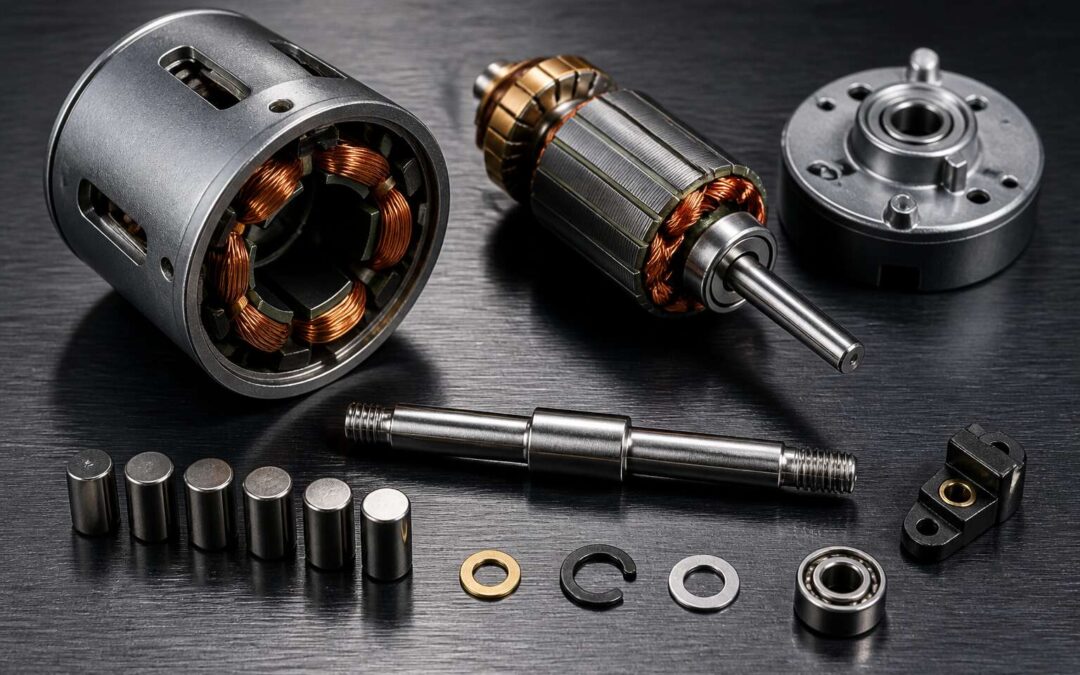
Common Applications of Compact Motors
Automotive Auxiliary Systems
Modern vehicles run on more than fuel. They run on dozens of auxiliary systems hidden behind the dash, inside doors, and under the bonnet. Compact electric motors small enough to fit in a palm handle tasks drivers take for granted: window regulators, mirror adjusters, blower fans, and seat recliners.
A single luxury sedan can contain over forty such actuators. In South Africa, with its stop-start traffic and uneven roads, these components face constant abuse. They must withstand heat, vibration, and dust while delivering precise movement. Interestingly, a seat motor needs torque, while a mirror actuator needs finesse. Both rely on the same fundamental design: a tiny armature spinning inside a magnetic field. These electric motors small in size are how modern cars deliver comfort and convenience. Without them, we would still be cranking windows by hand.
Medical Devices and Lab Equipment
In medical settings, precision is a matter of life. A syringe pump delivers a drug at 0.1 millilitres per hour, relying on electric motors small enough to fit inside the device’s chassis. These microdrives operate silently, with torque consistency that manual handling cannot match.
Laboratory automation presents another challenge. Centrifuges spin at 15,000 RPM, while robotic pipettors move microlitres across plates. Each motion requires controlled angular velocity and minimal backlash. Engineers specify compact units with high resolution, often using brushed DC designs for simplicity or stepper variants for exact rotation.
- Surgical saws demand compact power density to cut bone without excessive heat.
- Anaesthesia ventilators need quiet, responsive actuators for gas flow regulation.
- Portable analysers use miniature gearmotors for blood sample agitation.
South African laboratories face dusty conditions and intermittent power. Motors must tolerate voltage fluctuations while maintaining positional accuracy. The chassis seals around these electric motors small, protecting them from contaminants that would degrade performance.
Robotics and Automation
A single robotic arm in a Gauteng fruit packhouse makes 40 picks per minute. Each pick depends on electric motors small that reverse without stalling. The electric motors small inside these joints often use harmonic drives to eliminate backlash. Their low rotor inertia allows rapid direction changes without overshoot.
Consider a sorting system in Johannesburg running 24/7. Every rotation must be exact, despite voltage dips from the grid. I have seen engineers specify coreless DC motors for smooth torque. Others prefer stepper variants with gearboxes. Both handle the dust that sneaks past seals.
- Pick and place arms for tray loading
- Conveyor diverters for parcel routing
- Automated guided vehicles for pallet movement
The challenge is always heat dissipation. Compact designs pack more copper into each slot, but they also concentrate thermal load. Thermal modelling becomes the real art.
Consumer Electronics
Every tap on a smartphone screen carries a physical reply, a micro pulse that confirms your action. That pulse comes from electric motors small enough to sit inside a housing thinner than a coin. Haptic actuators, linear resonant actuators, deliver precise vibrations for notifications and gaming feedback.
In drone cameras, compact gimbal motors counter each gust with millimetre corrections. A pilot hovering over Cape Town’s coastline gets stabilised footage because three electric motors small work in synchronous tension. The heat they generate dissipates through magnesium frames and passive airflow.
Consumer robotics relies on the same principles:
- Robot vacuums map rooms using wheel encoders driven by tiny geared motors.
- Electric toothbrushes use resonant drives that oscillate at high frequency.
- Smart blinds adjust to daylight via motors that draw less than one watt.
None of these devices tolerate stalling. The motors must start, stop, and reverse thousands of times without losing position.
Choosing the Right Miniature Motor for Your Project
Voltage and Power Requirements
In the South African workshop, where load shedding dictates the rhythm, voltage is a constraint, not a suggestion. When selecting electric motors small, the nominal supply voltage often masks the reality of your application. A 12V motor may run beautifully in a lab, but a 15% voltage drop on a long cable run leaves it sluggish.
We often overlook running current! Match it to your power supply’s continuous rating. Starting surges are fleeting, but the sustained draw is the real cost. Consider these factors:
- Measure actual line voltage under load.
- Account for ambient temperature.
- Choose a gearmotor to boost torque without inflating current.
Power requirements are where ambition meets physics. Electric motors small convert electrical watts into mechanical output with 70 to 85 percent efficiency. The remaining energy becomes heat, and heat is your enemy in a sealed enclosure. That inefficiency dictates the cooling solution size; without it, the project fails.
Torque and Speed Considerations
Torque and speed define the operating envelope of electric motors small, and most selection errors come from ignoring one at the expense of the other. A motor rated at 5,000 RPM looks impressive on paper, yet a real load drags it toward stall. The demand is a curve, not a single point.
- Stall torque is the absolute ceiling; measure it at your actual supply voltage, not the datasheet value.
- Speed under load matters more than the no-load number painted on the label.
- Reduction ratios trade speed for torque, but each gear stage consumes efficiency.
Gearing reshapes the torque-speed relationship, yet every mesh adds backlash and losses. Pick the combination that puts your operating point near peak efficiency. That is the region where a miniature drive quietly works for thousands of hours.
Size and Form Factor Constraints
Nothing kills a project faster than a motor that does not fit. In a compact housing, every millimetre of motor length changes the mechanical layout. Electric motors small enough to fit a 20 mm bore still need space for connectors and cooling. Your form factor is not a choice; the product enclosure fixes it.
Mounting points dictate vibration behaviour. Shaft orientation dictates the gearbox. The list of constraints grows quickly:
- Body diameter and the tolerance of your bracket
- Shaft length relative to the coupling hub
- Thermal interface area for sustained operation
Any of these can negate a datasheet. I have watched projects stall because a flange could not accept the required screw pattern. Measure your cavity. Then measure again. The best electric motors small in body are also precise in operation, but they will not shrink to fit your oversight.
Noise and Vibration Levels
Acoustic emissions from electric motors small enough for portable devices often reach 45 decibels under load. That measurement sits below conversational speech, yet it can ruin a quiet recording studio. A motor that hums at 60 hertz may excite resonances in a plastic housing, masking the motor’s actual condition.
The mounting interface matters! Hard mounts transmit every harmonic into the chassis. Soft mounts absorb energy but introduce compliance, altering the system’s natural frequency.
- Measure the operating speed range and compare it with structural resonances
- Check for audible whine from the commutation system, not just the bearings
- Test the motor inside the actual enclosure before committing to a supplier
A professional engineer once told me that a quiet motor in free air becomes a noisy motor in a bracket. The enclosure, the coupling, and the load modify the acoustic signature. electric motors small can amplify vibration if the frame resonates.
Cost vs. Durability Trade-offs
A field study of 500 actuators found 38% of failures trace to cost cutting. Specifying electric motors small on price alone leads to hidden costs. A unit costing R120 less may need replacement after 3,000 cycles. Disassembly, calibration, and production stops add expense. In one line, a motor caused R4,800 in lost output. Durability starts with materials: stainless shafts and copper windings survive harsh environments better than cheaper counterparts.
For most projects, the decision hinges on the duty cycle. An intermittent actuator in a consumer gadget can tolerate a budget motor. A continuous-duty pump cannot. I once chose a low-cost variant and regretted it in six months; the brushes wore to dust. The extra R80 would have bought a sealed unit with a 10,000-hour rating. That trade-off is clear when computing cost per operating hour. Electric motors small offer the widest price variance because durability thresholds differ sharply across applications.
Comparing Motor Types for Limited Spaces
Brushed vs. Brushless DC Motors
When space is at a premium, the choice between brushed and brushless DC motors becomes a calculation of trade-offs. Brushed motors are simpler and forgiving, but they generate heat and require maintenance. Brushless motors run cooler and last longer, yet they demand more complex control electronics.
For compact enclosures, the heat factor is critical. A brushless motor’s efficiency means less wasted energy inside a sealed cavity. Consider how each type behaves under constant load:
- Brushed motors handle short, intermittent bursts without issue.
- Brushless motors maintain stable performance during continuous operation.
The real suspense lies in the hidden costs. A brushed motor’s commutator wears down, and in a confined space, replacing it is a frustrating exercise. Brushless motors eliminate that failure point. For electric motors small in size, the brushless option often saves your design from thermal disaster. But the added electronics consume precious cubic millimetres.
Stepper Motors for Precision Control
The space constraints of modern devices force a direct comparison between motor architectures. Coreless motors deliver high acceleration for their diameter, but they generate heat. Gearmotors multiply torque, yet backlash introduces positional error. Stepper motors handle precision differently. They rotate in fixed increments, so the controller knows the shaft angle without feedback circuitry.
For electric motors small enough to fit a camera gimbal or a microfluidic pump, steppers offer a clear benefit. They eliminate encoders and their wiring. The downside appears at standstill, where holding current produces warmth. Still, for applications requiring exact positioning, repeatability outweighs the thermal cost.
- Coreless motors: fast, lightweight, thermally demanding
- Gearmotors: high torque, measurable backlash
- Stepper motors: deterministic positioning, heat at rest
The ranking depends on whether speed or certainty matters most.
Coreless Motors for High Efficiency
When floor space is measured in millimetres, the choice between motor architectures becomes a question of thermal management. Coreless motors offer the highest efficiency for electric motors small enough to fit inside handheld devices. Their ironless rotors eliminate cogging and magnetic drag, so more input energy converts to rotational motion rather than waste heat.
Consider the practical differences:
- Coreless motors: high efficiency, rapid response, limited stall torque
- Iron-core motors: higher torque density, lower cost, more cogging
- Stepper motors: precise increments, heat at standstill
A coreless motor in a compact drone gimbal draws less current per gram of thrust. That efficiency matters in battery powered designs. In confined spaces where energy is scarce, coreless construction delivers measurable gains over iron-core alternatives.
Gear Motors for Increased Torque
I have watched engineers spend hours selecting the perfect motor, only to find the gearbox is the real constraint. In tight enclosures, the motor architecture receives attention while the transmission determines survival in the field.
Gear motors solve a specific problem. Direct drive motors with sufficient torque become too large for the space. A planetary gear stage multiplies torque without expanding the housing diameter. Compact mechanisms rely on them.
For electric motors small enough to fit inside handheld tools, the gear ratio provides mechanical advantage. Options differ:
- Single stage planetary: mild reduction, higher output speed
- Compound planetary: greater reduction, added length
- Worm gear: right angle output, high ratio, lower efficiency
Each choice trades responsiveness for holding power. The correct answer depends on whether the load is intermittent or continuous.
Efficiency and Energy Savings in Small-Scale Drives
Reducing Friction and Heat Loss
In the quiet hum of an electric motors small, there is a hidden toll. Every rotation carries a cost in friction and heat, energy that quietly erodes performance and lifespan. I have seen small scale drives lose nearly a fifth of their input power to thermal loss, a silent expenditure that operators often overlook.
Reducing this waste begins with bearings, lubrication, and the alignment of moving parts. Lower friction produces lower temperatures. Lower temperatures slow the degradation of insulation and magnets. Temperature rise accelerates wear across the entire assembly.
Consider the usual suspects:
- Overlubricated bearings that churn and resist
- Misaligned shafts grinding against their housings
- Poor ventilation trapping heat inside the frame
Each adds resistance. Each costs you! Efficiency in electric motors small is a discipline of precise maintenance and honest observation.
Optimizing Motor Drivers and Controllers
Approximately 68% of industrial electrical energy is consumed by motor systems. For electric motors small, the difference between waste and efficiency often lives in the controller. The driver is the brain, and a lazy brain makes for a wasteful muscle.
A poorly tuned controller forces the motor to draw excess current, converting precious electricity into nothing but heat. The modern approach is field-oriented control, or FOC. It treats the motor’s magnetic fields with precision, allowing for smooth torque at any speed. The gains are real:
– Reduced harmonic distortion that heats up windings
– Dynamic response that matches load demands instantly
– Lower audible noise from switching frequencies
Many operators use pulse-width modulation that is simply too coarse. The result is a motor that shudders and strains. A refined driver changes the game entirely. It modulates voltage and current as a single, coherent unit, ensuring electric motors small operate at their peak magnetic efficiency. This is the quiet victory, measured in a lower monthly bill and a cooler running machine.
Battery Life Impact in Portable Devices
Every joule saved in a portable device extends the gap between charges. For electric motors small, this relationship is existential. A motor that draws 30% less current does not merely run cooler; it redefines the product’s usefulness. The battery’s capacity is finite, and the motor’s power draw determines the operating duration.
Small scale drives in handheld tools, medical sensors, and remote monitors face the same arithmetic. Energy efficiency in this realm is not a luxury. It is the difference between a device that survives a field shift and one that fails before noon.
Consider what drains a lithium cell:
- Copper losses from winding resistance
- Switching losses in the driver stage
- Standby current from poor low power modes
Each item is addressable through better motor selection and tuned control. Electric motors small with coreless rotors or low cogging designs show measurable gains. In my experience, operators notice gains in weeks, not years.
Operating Temperatures and Insulation Class
In small-scale drives, efficiency is measured in wasted heat. Copper loss, iron loss, and windage convert input energy into temperature rise. Electric motors small face a paradox: the smaller the frame, the harder it is to shed thermal load. Insulation class determines lifespan. Class B tolerates 130 degrees Celsius. Class H pushes to 180. Choosing wrong ages a motor inside a South African enclosure in months.
Operating temperature degrades magnets. A neodymium rotor losing 10 percent of flux forces a 10 percent jump in current draw. That extra current raises heat further, ending in demagnetization.
Thermal design relies on three choices: stator lamination grade to cut eddy current heating, winding fill factor to conduct heat toward the housing, and rated ambient temperature matched to the site.
Efficiency gains appear first in reduced copper loss, then in cooler bearings, and finally in extended insulation life. For electric motors small, each joule not converted to heat preserves the magnetic circuit.
Maintenance and Longevity of Miniature Drive Systems
Bearing Care and Lubrication
Every miniature bearing spins inside a housing smaller than a coin, yet its care determines the lifespan of the entire drive. For electric motors small, lubrication is not a one-time event. It is a calculated choice between viscosity, temperature, and contamination. South African environments add moisture and abrasive dust to the equation, accelerating wear in unlubricated or over-lubricated systems.
Observing the motor’s behaviour reveals the bearing’s state. A rising hum, a rough start, or a slight temperature increase often precede failure. These cues are easy to dismiss in sealed units, where the initial grease charge must last for the product’s life. Manufacturers select that charge based on load and speed, but users rarely consider it.
- Unusual vibration at constant speed
- Dark grease streaks escaping the seal
Such signs point to bearing degradation, not motor failure. Correct care begins with understanding that the bearing, not the coil, usually gives out first.
Brush Replacement and Commutator Wear
The bearing fails first, but the carbon brush is never far behind. For electric motors small enough to fit between two fingers, brush wear directly changes the commutator surface. Each start deposits copper dust. That dust is not debris. It records the contact pressure and current density inside the unit.
Commutator wear usually appears as a dark ring. The ring forms unevenly when spring tension sags. A motor that slows under load while humming louder often has a worn brush seat. These symptoms do not announce themselves with sudden stops. They build over days.
Signs that require immediate attention include:
- Erratic armature response at steady speed.
- Visible grooves on the commutator face.
Brushed machines eventually need a new brush. The commutator can survive several brush changes, provided the surface stays round. Periodic no-load running seats the brush and evens the film across the bars.
Contamination Prevention
Every seasoned technician knows that the real heartbeat of a machine lies in the quiet interaction between the carbon brush and the commutator. We’ve already covered the gritty details of bearing failure and the inevitable dust that follows, but the story doesn’t end with a simple replacement. The surface of the commutator itself is a living record of the motor’s health, a copper chronicle that tells tales of pressure, heat, and electrical stress. When you inspect a motor that has been running under duress, you might notice a distinct dark ring developing around the commutator’s circumference. This is not a superficial blemish; it is a physical manifestation of the commutator surface changing under prolonged electrical and mechanical load. That dark ring is the first whisper of uneven wear, a sign that the brush seat is not making perfect, uniform contact. It is a warning written in copper and carbon, one that grows louder and more insistent if ignored.
As the days pass and the motor continues its labored humming under load, the situation can progress from a whisper to a shout. An armature that once spun with silent precision may begin to exhibit erratic responses, its speed fluctuating or its response to control inputs becoming sluggish. This is often accompanied by a perceptible change in the acoustic signature of the device; the smooth whir is replaced by a louder, more strained hum that seems to vibrate with frustration. These symptoms do not announce themselves with a sudden, dramatic stop, but rather build their presence over days and weeks, slowly degrading performance until the problem becomes undeniable. The root cause is often a loss of spring tension, which allows the brush to chatter and bounce rather than glide. This erratic contact is what etches those visible grooves onto the commutator face, each groove a small canyon carved by inconsistent current density.
Once grooves appear, the situation demands immediate intervention. Ignoring them is an open invitation to catastrophic failure, where the motor’s performance becomes dangerously erratic. The troubleshooting checklist for a motor exhibiting these signs is straightforward but requires a methodical eye. Consider the following warning signs that should trigger an immediate inspection and likely a brush change.
- Erratic armature response at steady speed, indicating a loss of smooth contact.
- Visible grooves on the commutator face, which act as physical barriers to efficient current transfer.
- A distinct dark ring that does not polish away with normal seating, signaling a change in the surface film.
- A motor that slows significantly under load while humming louder than usual.
The good news is that brushed machines are remarkably resilient. Provided the commutator surface remains round and true, it can often survive several brush changes before needing more serious attention. Each new set of brushes, given a proper periodic no-load running period, will seat themselves to the existing surface and gradually even out the microscopic film across the bars. This self-healing property is one of the great advantages of brushed technology, offering a path to longevity that is both simple and cost-effective. The key is to never let the wear progress to the point where the commutator’s shape is compromised; a grooved surface is a damaged surface, and no amount of new carbon will fix that underlying mechanical issue.
So, while the prospect of maintenance might seem daunting, it is a manageable and predictable part of owning these workhorses. The relationship between brush and commutator is a partnership, and like any good partnership, it requires attention and care to flourish. By understanding the subtle signs of wear, like that ominous dark ring and the eventual grooves, you can intervene at the right moment. This proactive approach not only extends the life of the motor but also prevents unexpected downtime. And in the grand calculus of repair costs, a simple brush change is infinitely preferable to a full rewinding or replacement. The durability is there, but it is a conditional durability, one that rewards the observant and punishes the negligent.
Condition Monitoring in Industrial Environments
Condition monitoring transforms how we care for electric motors small. Instead of waiting for audible distress, we track subtle variables like winding temperature and current harmonics. In industrial environments, these signals often precede mechanical breakdown by weeks.
Vibration analysis remains the most telling metric. A spectral shift of even a few hertz can indicate bearing fretting or rotor imbalance. Thermal imaging adds another layer, revealing hotspots that strain insulation systems. Together, they yield precise foresight.
- Track phase resistance consistently
- Log ambient humidity and dust load
- Compare startup current profiles
This data turns maintenance from guesswork into calculated foresight. The payoff is disproportionate. A modest sensor budget extends operational life significantly. We observe, we anticipate, we intervene before failure! That is the essence of industrial care.